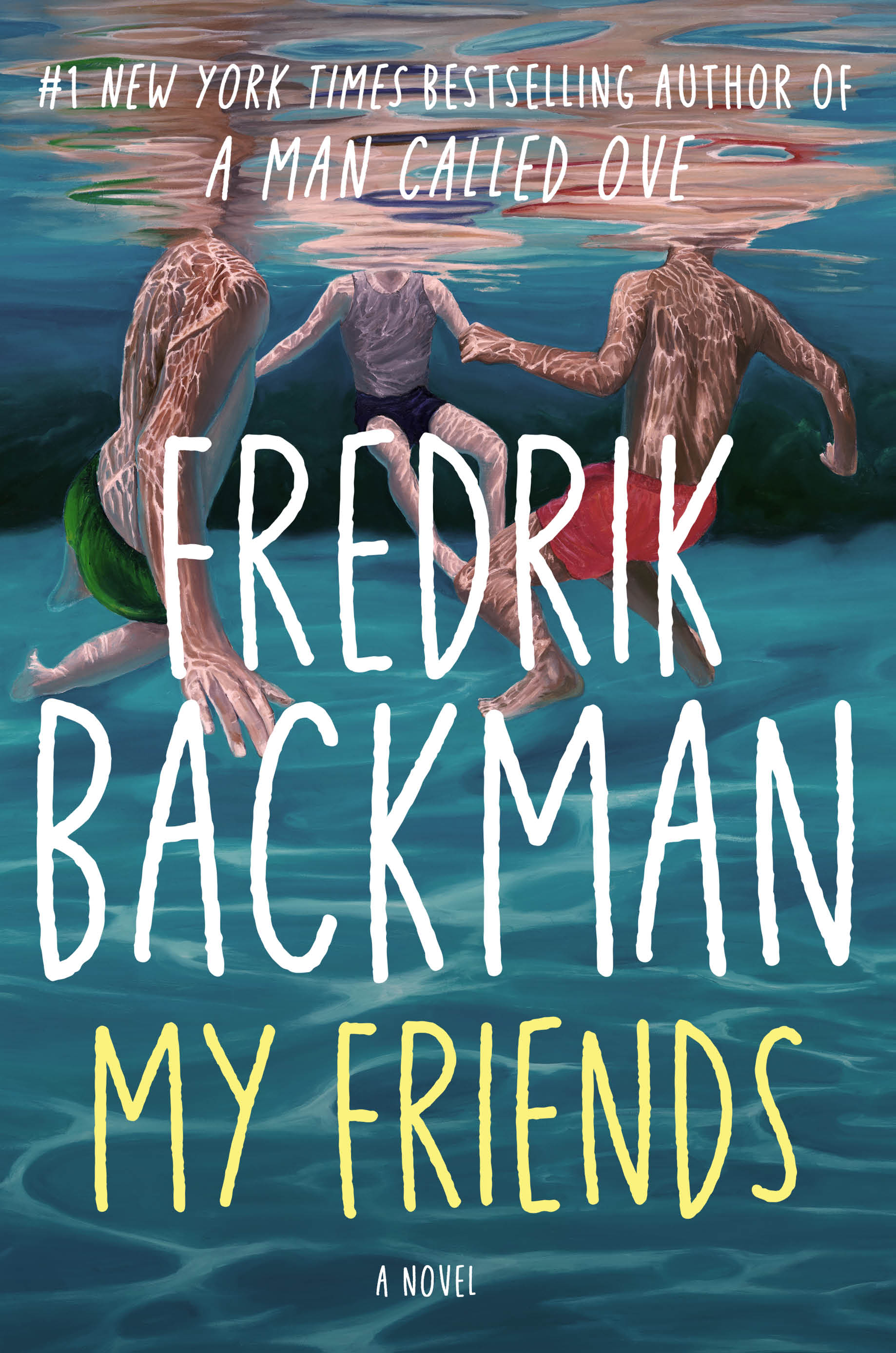
My Friends

By Fredrik Backman

Louisa, a foster kid, now homeless, is about to turn 18. Since the tragic death of her only friend, Fish, Louisa has nothing dear to her heart other than a postcard picture of a painting called ‘The One of the Sea’ by artist CJat (later we learn the artist’s real name is KimKim). This painting, a symbol of hope and beauty, becomes a central motif in the novel. Breaking into the gallery where the real painting is to be sold, Louisa is found out and attempts to run away from the guards. She unexpectedly and literally runs into a homeless man who coincidentally happens to be the artist himself. Now, it all sounds too coincidental to be true. Still, Backman writes in such a way that turns coincidence into serendipity. Flashback 25 years, and we learn the genesis of the painting. We are enmeshed in the lives of the author and the three friends who all needed to rely on each other to survive the trauma and heartaches of their childhoods. Joar is the protector. A Child of an incredibly abusive father yet a gentle, loving mother, Joar. And, of course, Ted, who endures the death of his father after a prolonged sickness. Ali is a young girl with a single father with a nomadic lifestyle. Each of these young people was lucky enough to have found each other at a time when they were suffering from traumatic childhoods.
The novel is structured, alternating between two time periods. In the present day, we follow Louisa as she meets Ted, now an adult, and begins to unravel the story behind her beloved painting. The second timeline, set decades earlier, immerses us in the lives of ‘the friends.’ 
I loved several elements of this book; I especially loved the idea of people who, when they find someone who is “one of us” (an artistic, sensitive soul), will do anything to protect and encourage them to flourish not only in their craft but in life itself. I also love that even though this novel is rife with trigger warnings (suicide, abuse, neglect), the characters are portrayed as pure-hearted, loyal and warriors against their specific demons.
This novel’s primary theme is friendship and how true friendship survives trauma, conflict, and time.

Thank you to Atria Books and Netgalley for the copy.

Oye

by Melissa Mogollon

Rarely is a novel so effectively written that you feel like you are a part of the family. Such it was for me with Melissa Mogollon’s Oye. Luciana is our protagonist; in fact, through her phone calls to her sister Mari, we are given access to her story, albeit her side of the story. Luciana’s voice is so convincing that I felt as though I was speaking to my sister, and boy, did I often find her annoying, moody, and melodramatic; mind you, Luciana is only 17 years old, so that’s that. 
The story starts with Luciana informing her sister Mari (who is away at university and therefore not directly a part of the family drama)of the family’s plans to evacuate due to Hurricane Erma. This life-threatening situation forces them to confront their relationships and responsibilities. Luciana is naturally stressed because she is left with her mother to convince her Abue to go with them. However, they notice that Abue is in desperate need of medical attention. Sure enough, Abue is diagnosed with a life-altering condition. Therefore, it is up to Luciana to manage the family trauma. Luciana’s Abue is one of the most charismatic characters I have met…a 70-year-old who views herself as a femme fatale, and you know what…she kinda is. 
Accompanying her Abue on her medical journey, Luciana learns about her family history, a history filled with heartache, trauma and unforgivable decisions.
Oye is a novel that beautifully captures the process of character development. Luciana’s ‘coming of age’ is a gradual and gentle journey, which adds to her authenticity. The novel’s prose is a testament to how diction, tone, and word choice can effectively shape a character, making it a perfect mentor text for teaching character development. 
The author also utilises some incredibly beautiful ( as well as humorous) metaphors. For example, “Starfish are reminders to heal yourself… to pause and regrow your own body parts first.”
There is no huge quest, no dragons to slay, or princes to save, but this novel portrays an incredibly realistic way of how family relationships, responsibility, identity, and forgiveness are essential for peace and understanding of self and others.

Dreadful

by Caitlin Rozakis

This book reminded me much of Susanna Clarke’s Clarke’s Piranesi, except lighter and less literary. Its premise also reminded me a bit of Gordon Korman’s Korman’s Restart. We’ve got a protagonist who has no sense of who or where he is and has to try to survive a number of obstacles (both death-defying and personal) in the quest to find out his reality.
Our protagonist wakes up and finds himself beaten and bruised in a destroyed lab, an imprisoned princess, and the threat of the Dreadful Lord Gravrax. He has lost all sense of memory and identity; however, he soon finds out (with insightful guidance from the princess) that he, unfortunately, is the Dreadful Lord himself.
The novel’s humour and tone helped me through the times when the plot was slow. This is a fun, lighthearted, and, at times, humorous fairytale-esque novel that successfully discusses the themes of identity, appearance, and the importance of memory in defining oneself.

Thank you to Netgalley and Titan Books for the copy!

What Feasts At Night (Sworn Soldier Series #2)

by T. Kingfisher

As a huge fan of the first book in the Sworn Soldier series, What Moves the Dead, I was so excited to read this second novella and see what adventures befall Alex Easton after their nightmarish experience at the Usher Estate (review here). 
Alex and their loyal, albeit grumpy valet Angus return home to Gallacia, specifically to the family hunting lodge. They are motivated mostly by their new friend Mrs Potter (whom we met in the previous novella) ‘s desire to study the mushrooms indigenous to the Gallacian mountains. 
What was hoped to be a leisurely and restful vacation is anything but. First of all, the caretaker of the lodge has unexpectedly died a mysterious death. No one in the village, especially the caretaker’s daughter, wishes to talk about the circumstances of his death…but his death is clouded by superstition and terror. As well, Alex is plagued by a recurring nightmare of a ghoulish woman who sits on their chest and steals their breath. This nightmare conveniently plays into the local superstition of the moroi.
Not one for superstition, Alex, Angus, and Mrs Potter (who is a woman of science, after all) are determined to come to a more logical understanding of Alex’s nightmares, which turns out to be more difficult than they first believed.
I so enjoy Kingfisher’s writing. I especially like the Sworn Soldier series (so far), which are both charming yet horrifying at the same time. A delightful combination!

Thank you to Netgalley and Tor Publishing for the copy!

Devouring Tomorrow

This anthology of speculative fiction is an impactful text to use not only in English but in Biology as well. Each story, written by Canadian authors, centres around the future and what would happen if the world experienced a food shortage. The stories talk of the repercussions of human behaviour on the environment and the perspective that we might have to resort to feeding the human race (yes, a couple of the stories talk of “synthetic cannibalism”. I found each of these stories immensely thought-provoking, and several were hugely disturbing because of their “I could see this happening” realism. The potential for dynamic Socratic Discussion around the themes of EVERY one of these stories is immense. 

With Canadian authors, speculative fiction, and timely themes, this anthology offers a rich ground for deep, stimulating discussions about the consequences of humans’ impact on the environment and the morality of unequal resource distribution.

Trigger warnings: language (for a few stories) and disturbing content…however, it varies per story.

Small Ceremonies

Kyle Edwards

Although this novel has multiple narrators, the story centres around two characters; Tommy Shields and Clinton Whiteway. Tommy and Clinton, like many of us, play for the St. Croix Tigers, an inner-city hockey team in Winnipeg. The Tigers haven’t won a game in so long they are rumoured to be cursed. The novel follows Tommy and Clinton as they navigate their final year of high school and what their future may entail. Both characters have tremendous obstacles to face, whether it be a mentally ill mother or a convict brother intent on recruiting his younger brother for the drug trade. 

Edwards centres his novel around hockey and the Tigers’ degree of success. At the end of each section, we get a chapter in italics written from the point of view of a hockey commentator. Each of these nail-biting chapters presents the Tigers’ potential gains and heartbreaking losses, symbolic of the gains and losses of our two main characters.

The accuracy of detail in Edwards’s writing is astonishing. He brilliantly describes “small town” (even though it’s Winnipeg) hockey culture, from the locker room to the history of the Zamboni driver to the make-up of the fans in the bleachers. Edwards is also gifted in creating nostalgia, meeting your childhood best friend, for example, and playing marbles on the playground.

This novel humorously yet heartbreakingly describes the Indigenous experience in Canada, and the reader really does hold both Tommy and Clinton close to their hearts as we follow them on their journey of self-discovery.

It is a wonderful and effective mentor text, not only for the themes of coming of age, identity and place, overcoming trauma, racism, and friendship, but also brilliantly written. Edwards’s writing would be very effective for teaching descriptive writing, character development, setting, developing the setting as a character in itself, organizing a story atmosphere and tone, and dialect.

Trigger warnings: childhood trauma, intergenerational abuse, mental health, substance abuse, racism. 

Sunrise On the Reaping

by Suzanne Collins

Years ago, I was a fan of the Hunger Games series, and I read the first book aloud to my ninth-grade class. They naturally loved it. I was delighted to find out that Collins has now written a prequel from Haymitch’s point of view. 

Written in first person, we, the reader, get to know Haymitch personally. The novel unfolds on Haymitch’s 16th birthday, the day of the Reaping. Despite his numerous entries to secure food and supplies for his family, Haymitch has avoided being chosen. We delve into the intricacies of the Haymitch family, his ties with the Everdeen family, his fears, his wit, and most importantly, his love for Lenore Dove.

As we all know, Haymitch is, in fact, chosen to represent District 12 for the Hungar Games, even though the circumstances under which he is chosen are questionable. 

Of course, the novel’s main action occurs in the Arena for the Hunger Games. Due to specific meetings and acquaintances, Haymitch’s task in the Arena isn’t just to survive; it is to sabotage the Game in the hopes of bringing down the Hunger Games and, ultimately, President Snow.

This novel, in line with the Hunger Games series, is intense and fast-paced. I found it intriguing to unravel the layers of Haymitch’s character and understand the roots of his eventual struggles with substance abuse. Suzanne Collins’ incorporation of verses from Edgar Alan Poe’s poem “The Raven” creates a perfect opportunity for teachers to discuss patterns and connections between the two pieces of literature. The poem’s verses beautifully mirror Haymitch’s feelings towards Lenore and his trauma in the Games, particularly in the final chapter.

Collins also employs nursery rhymes and the lyrics from The Hanging Tree to help support themes.

Trigger warnings: extreme brutality, murder and death.

The River Has Roots

by Amal El-Mohtar

“There was a time when grammar was wild-when it shifted shapes and unleashed new forms out of old. Grammar like gramarye, like grimoire. What is magic but a change in the word…but that is the nature of grammar-it is always tense, like an instrument, aching for release, longing to transform present into past into future into will. (pg. 1-3)

The Hawthorn sisters, Esther and Ysabel, live in the small village of Thistleford located on the edge of “the beautiful county of Acadia, the beautiful land- the land beyond; antiquity”  in other words, the beautiful land of Faerie. The sisters have 2  jobs: the first is to weave beautiful willow baskets, and the second most important is to sing to the willows. You see, “when they sang together, you could feel grammar in the air”. Ester, the eldest, is being pursued by the bachelor Mr. Pollard, who “always had the beseeching expression of a whining dog; his hand, bafflingly, were always somehow both cold and moist”…needless to say, Esther is in no way interested. Instead, her heart belongs to Rin (a beautiful nonbinary character). Rin is Fae; Rin is beautiful, loving, brave, and adoring. However, Ester is in a dilemma; although she loves Rin, she vows to never break the bond she has with her sister Ysabel. She loves her sister beyond life itself, and their bond is intricately woven together, not just because they are sisters but because of the magical bond created by the grammar when they sing.

When a violent incident occurs and tragedy strikes, Esther has to choose between living in the world of Faerie with her love and staying in human form or living in the land of humans in the form of a swan. Will the bond between the sisters survive the conflict that ensues? 

This novel is a treasure trove for literary analysis. Its symbols, including the river Liss, the Willows, Mr Pollard, and the land of Faerie, are rich and complex, offering ample material for exploration. The novel’s prose, too, is a delight, best savored when read slowly and contemplatively, much like a piece of poetic verse.

This novel is also beautifully published, interspersed with what looks like linocut artwork by artist Kathleen Neeley, enchanting and folkloric.

If you loved How To Lose the Time War, co-written by El-Mohtar you love this novel.

Victorian Psycho

by Virgina Feito

Okay, I’ll admit, I found this novel disturbingly entertaining. If you’re squeamish about blood, body horror, and violence towards children and adults, this book is not for you. It’s a darkly funny, gory, and disturbing read, with not a single sympathetic character in sight. Yet, I was so engrossed in the depravity of the characters, particularly our main character, Winifred Notty, that I couldn’t put it down, finishing it in a single day.

Basically, poor Nanny Notty suffered a traumatic childhood, which could be seen as a contributing factor towards her psychopathy; however, I felt as though she was also a creature of nature and not purely nurture. Winifred finds work as a nanny in a wealthy household where the children are as horrendous as the children. The plot is somewhat limited, and I believe it basically exists to develop the characters in such a way that makes us, the reader, not at all sad to see them die. It is written from Winifred’s point of view, and her thoughts are amusing because she is such a wry, condescending character.

Theme? Basically, it’s a story of a poor, underprivileged woman who gets a chance to exact rage and resentment against the societal group that has historically repressed and abused her, and her revenge is gloriously bloody.

Apparently this novel is being made into a movie!

Thank you to Netgalley and Liveright/Norton for the copy.

The Amalfi Curse

by Sarah Penner

Haven Ambrose has found her way to Positano, Italy, to lead a team of archaeologists in researching sunken wrecks off the Amalfi Coast, a place rich in history filled with folklore of curses and witches. But Haven isn’t there to study history folklore or besides her research, Haven has a second more personal reason for participation in this expedition, before her father’s death, he, as a renowned nautical archaeologist himself died he made her promise to return to his last dive site where he believed he had found a lost trove of rare gemstones.  No one on Haven’s expedition team knows this; if they did, they would be sure to claim them for their own. 
Upon her arrival, Haven is immediately drawn into a mysterious incident: a yacht is ensnared in a whirlpool, collapses, and vanishes beneath the waves, taking most of the crew with it. Could this tragedy be linked to the fabled Amalfi Curse?
Now, for the second timeline, there is indeed a second timeline that occurs more than 200 years before Haven’s arrival. This is Mari’s story. In Positano, the women are stregheria- sea witches who protect their village from pirates, specifically the infamous Mazza brothers. Mari is the most powerful strega, and she is integral to the success of the protection spell. The only problem is that she longs to escape her home and run away with her American sea-faring lover to live a life away from the unpredictable sea. 
The two timelines are masterfully interwoven, keeping me engrossed and endearing me to both female protagonists. Yet, the portrayal of the female community and the potency of the stregheria truly captivated me. This novel had me delving into Italian folklore, sea witches, Positano, and the Amalfi Coast, sparking a desire to visit these places.
I wish a few plot points were fleshed out a bit more, and I would have appreciated a bit more backstory for a couple of the characters.
The Amalfi Curse is a perfect novel for your summer reading list.

Thank you to Netgalley and Park Row Books for the copy!

Blood on Her Tongue

by Johanna Van Veen

This is the second novel I’ve read by Johanna Van Veen, and it just confirmed to me that she is, in fact, one of my favourite authors. I do not naturally gravitate to horror, but when I have, it is usually to authors such as her. Before you read this novel, be sure to read the forward; it does prepare the reader for what lies ahead. Yes, it is creepy, yes, it is bloody, but it’s also a whole lot of fun. This novel will keep you entertained from start to finish. In fact I was so intrigued that I read it in a day!

Set in what I believe to be the Victorian era, Lucy receives a very unsettling letter from her twin, Sarah. Sarah’s letter is incoherent, pleading, and desperate, and her handwriting is beyond agitated.

Sarah’s letter was soon followed by her husband’s letter, requesting Lucy come to Sarah’s assistance.

Lucy isn’t completely surprised by this; madness, after all, does run in the family.

When Lucy arrives, in an effort to discover the cause of her sister’s madness, she begins to read Sarah’s journals. These journals aren’t just a person’s recollection of the day’s thoughts and events; they are also scholarly in nature. It seems a body has been found on the property, but not any body, a Bog Woman wonderfully preserved centuries after her demise. Sarah’s obsession over the Bog Woman seems to have ignited her madness, so much so that we, the readers, start to believe that she may, in fact, be possessed by the Bog Woman’s spirit because soon Sarah ceases to be Sarah as Lucy has known her to be.

As with most Victorian stories, the male characters are far from appealing. For instance, Sarah’s husband is dismissive, condescending, and extremely narcissistic, which makes him an unsympathetic character. However, Van Veen does not paint the sisters as sympathetic characters either, but the characterization did get me rooting for them at the end.

This novel is highly atmospheric. It is gruesome, suspenseful, and quite humorous at times (to the expense of a couple of characters). I enjoy Johanna Van Veen so much because, despite the heavy themes, the plot is gruesome fun. If you are not a fan of body horror, maybe stay away from this one, but if you enjoy a good, gruesome, spooky tale, you’ll definitely enjoy Blood on Her Tongue. 

Thank you to Netgalley and Poisoned Pen Press for the copy.

Haunt Sweet Home

by Sara Pinsker

Mara has been going through life thinking she is a nobody, a failure. There is nothing like a family Thanksgiving dinner to make her feel more like a loser, especially when her cousin Jeremy is there, Jeremy, who seems to have been born with a golden horseshoe up his butt. Unable to find a job that pays her bills, Mara takes a job (or did she beg?) with her cousin’s unique television show “Haunt Sweet Home”. Now, Haunt Sweet Home is not your typical home renovation show. It’s a show that not only films the renovation of a room or two, but also serves as a ghost hunter, recording any ghostly phenomena that happen to take place. The more frightening, the more significant the audience. 

As part of the filming crew, Mara has firsthand knowledge of the authenticity of the paranormal activity, but she is in no position to debate the ethics of the truth behind “reality TV.” Instead, she just does her job during the week and spends her weekends living out of a tent, attending to her wood carving, the only talent she acknowledges in herself. 

The book is written in first-person narrative and focuses more on Mara’s emotional development than the plot. Her personal running narrative is one of self-deprecation, self-searching and self-realization. Pinsker writes this narrative in a way that resonates with anyone who has ever felt insecure about who they are. Mara’s slow but steady realization of her strength is a journey many can identify with. But Mara does not come to this realization on her own; she makes a friend whilst on the job, someone who seems to know who she truly is, someone who appears to be just the right person to support her in this journey of self-discovery and growth, the only problem is, is this friend real or not?

This turned out to be a different “ghost” story than I expected. It is in no way scary; it is rather more of a story that is a running narrative of a young woman’s self-discovery and growth. A light, easy read but not scary or suspenseful. 

Thank you to Tor Publishing Group and Netgalley for the free copy

The Orphanage by the Lake

By Daniel G. Miller

Version 1.0.0

Hazel Cho thinks of herself as a tough, no-nonsense private detective, and she is, to an extent. Having to deal with angry clients who refuse to acknowledge the brutal truth behind the reality Hazel uncovers, living paycheck to paycheck because of a lack of clients due to her gender, and navigating a sticky relationship with a roommate, a cherished friend that would like to be more than friends. One day, a gift seems to drop from thin air; a prospective client comes her way with an offer that is too irresistible to refuse. Madeline Hemsley graces Hazel’s detective agency with a job that requires Hazel to investigate the disappearance of a young girl from St. Agnes Orphanage. If Hazel takes the job, she will be paid an exorbitant amount of money, but along with payment comes a list of guidelines and deadlines Hazel must follow or not get paid. 
Of course, this offer is irresistible to refuse. But immediately, the roadblocks and morsels of truth that arise make this “gift from thin air” seem more like a curse. 
The plot is quick-paced, which definitely helps create suspense, with smidgens of romance interspersed. The author gives us little snippets of Hazel’s back story and her motivation for picking this peculiar line of work. The characters all seem to fulfil a purpose in developing the plot and serve as credible suspects in the mystery. 
The Orphanage by the Lake is a perfect summer mystery to put on your tbr list.
Thank you to Netgalley and Poisoned Pen Press for the copy.