If Pets Wrote Poems

written by Susan Johnston Taylor and illustrated by Sandie Sonke
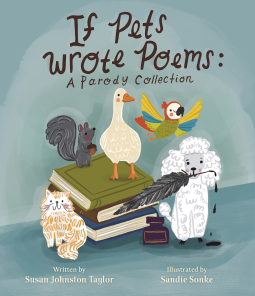
Ok, I absolutely loved this book. Poetry isn’t a genre I normally gravitate towards, even though I admire poets greatly…I could never write a great poem; however, Susan Johnston Taylor has approached poetry in such a unique and entertaining way that I couldn’t help but be charmed.

This book will, without a doubt, ignite curiosity about various authors through the perspective of their pets.

This children’s poetry book features poems written by pets. For example, Flush, Elizabeth Barrett Browning’s cocker spaniel, writes “To Elizabeth, My Person” in the style of Browning’s “To Flush, My Dog.” Naturally, students will want to find Browning’s poem to read more about Flush.

In another poem , apparently, Jack Kerouac owned a Persian Cat named Tyke. Tyke writes a poem called “One Mouse,” modelled after Kerouac’s “One Flower.” Did I look up “One Flower”? Yes, I did. 

And then there is my favourite, a poem written by Edgar Allan Poe’s Cat named Catterina, named “The Raven” written in the style of, yes, you guessed it, “The Raven”. Love, love, loved it. 

In my opinion, this book would be a wonderful addition to any classroom, from the earliest grades up to grade twelve. Featuring poems about the pets of their poets, it offers a unique and engaging way to inspire a love for poetry.

This book will be published in March 2026 —put it in your cart now for a wonderful surprise in the spring.

Thank you to Gnome Road Publishing and Netgalley for the copy.

The Haunting of Hecate Cavendish

By Paula Brackston

Ok, I LOVED this book. I loved the setting, I loved the atmosphere, I loved the characters, and I especially loved the writing. 
The novel takes place in England in the late 1880s, and Hecate goes to work at Hereford Cathedral to assist the librarian in sorting and caring for the cathedral’s extensive collection of books. Upon her arrival, Hecate soon discovers she can communicate with ghosts, and the Hereford Cathedral is riddled with ghosts! Hecate shares her gift with her father, who (being a scholarly man himself, somewhat knowledgeable in archaeology and the occult) is incredibly supportive of his daughter. 
All is well in the village until suddenly a murder occurs, and then another and then….
Hecate learns through her communication with the ghosts and her study of artefacts buried deep in the cathedral walls that a dark force has been unearthed and is beginning to wreak havoc upon the villagers. 
This novel has magic and mystery. It is a ghost story with fantastical creatures. The plot is detailed and intriguing, and the characters are engaging and interesting. Most of all, Brackston is a skilled writer with beautifully crafted prose.
It is always a treat to find a novel that not only entertains its readers with a compelling plot but can also serve as a mentor text for word choice and sentence structure. 
There is now a second novel in this series, called The Cathedral of Lost Souls, which will be published in November that I CANNOT wait to read.

Thank you to Netgalley and St. Martin’s Press for the copy.

Girls

Annet Schaap

I love the retelling of fairytales. Authors like Gregory Maguire and Angela Carter have successfully retold classic tales to make them commentaries on character, history and the social condition…just like original fairy tales were constructed to scare children to follow the straight and narrow. Annet Schaap’s short story collection Girls is one that I would put in league with Maguire and Carter.
Girls is a retelling of various fairytales, concentrating on girls and women in our society. The female characters are not princesses; instead, they are modern young women who face the same issues our female characters of old face: finding a husband, societal isolation, predatorial males, appearance, and abandonment. These characters, however, do not have handsome princes or fairy godmothers to rescue them. They have to rely on their own experience and grit to survive and make decisions for themselves independent of societal norms. Unlike classical fairytales, these stories don’t necessarily end with a “happy ever after”. Instead, they end realistically, if not melancholy, but always with our female protagonist, the designer of her fate.
This collection possesses a tonne of educational possibilities, making it a perfect anthology for study in grades 8-12, depending on which tale you choose to study. It could provide a rich analysis of the format as a mentor text, comparing and contrasting themes between traditional and modern retelling. Like conventional fairy tales, it offers ample opportunities for discussing symbolism and metaphor in-depth, enriching the student’s understanding of literary devices and their application in modern literature. 

Thank you to Netgalley and Pushkin Press for the Copy.

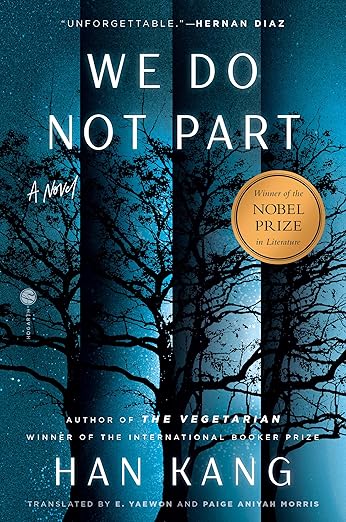
We Do Not Part

by Han Kang

The only other novel I’ve read by Han Kang was The Vegetarian, and I knew then that Kang was an author like no other. Using lyrical, poetic language rife with symbolism and metaphor, Kang takes deep political and historical issues and persuades us to think deeply about the human condition. The plot of  We Do Not Part is quite simple; our main character, Kyungha, receives an urgent text from her friend Inseon. Insean has suffered an injury and is being treated in a hospital in Seoul. Inseon tasks Kyungha to go to her home on Jeju Island to care for her bird, which has lost its mate and cannot live longer than a few days in isolation. 
Getting to Jeju Island is quite a task in and of itself; not only does Kyungha suffer debilitating migraines, but she now has to deal with incredibly unreliable remote transportation, blizzards, and hunger. Also, Jeju Island isn’t an island; it has a traumatic history where a massacre of tens of thousands of islanders had been slaughtered by anti-communist troops. This novel weaves from reality to surrealism, a ghost story, a psychological study, and a discovery of self.
This novel would make an amazing novel study for high school students. Not only would it serve as a mentor text, but it would also serve as a master class in writing. The themes it possesses would make for deep and meaningful class discussions.
Look at this beautifully descriptive quote: 
“Snow falls. On my forehead and cheeks. On my upper lip, the groove above it. It is not cold. It is only as heavy as feathers, as the finest tip of a paintbrush. Has my skin frozen over? Is my face covered in snow as it would be if I were dead? But my eyelids must not have grown cold. Only the snowflakes clinging to them are.”

Thank you to Random House and Netgalley for the copy.
Oye

by Melissa Mogollon

Rarely is a novel so effectively written that you feel like you are a part of the family. Such it was for me with Melissa Mogollon’s Oye. Luciana is our protagonist; in fact, through her phone calls to her sister Mari, we are given access to her story, albeit her side of the story. Luciana’s voice is so convincing that I felt as though I was speaking to my sister, and boy, did I often find her annoying, moody, and melodramatic; mind you, Luciana is only 17 years old, so that’s that. 
The story starts with Luciana informing her sister Mari (who is away at university and therefore not directly a part of the family drama)of the family’s plans to evacuate due to Hurricane Erma. This life-threatening situation forces them to confront their relationships and responsibilities. Luciana is naturally stressed because she is left with her mother to convince her Abue to go with them. However, they notice that Abue is in desperate need of medical attention. Sure enough, Abue is diagnosed with a life-altering condition. Therefore, it is up to Luciana to manage the family trauma. Luciana’s Abue is one of the most charismatic characters I have met…a 70-year-old who views herself as a femme fatale, and you know what…she kinda is. 
Accompanying her Abue on her medical journey, Luciana learns about her family history, a history filled with heartache, trauma and unforgivable decisions.
Oye is a novel that beautifully captures the process of character development. Luciana’s ‘coming of age’ is a gradual and gentle journey, which adds to her authenticity. The novel’s prose is a testament to how diction, tone, and word choice can effectively shape a character, making it a perfect mentor text for teaching character development. 
The author also utilises some incredibly beautiful ( as well as humorous) metaphors. For example, “Starfish are reminders to heal yourself… to pause and regrow your own body parts first.”
There is no huge quest, no dragons to slay, or princes to save, but this novel portrays an incredibly realistic way of how family relationships, responsibility, identity, and forgiveness are essential for peace and understanding of self and others.

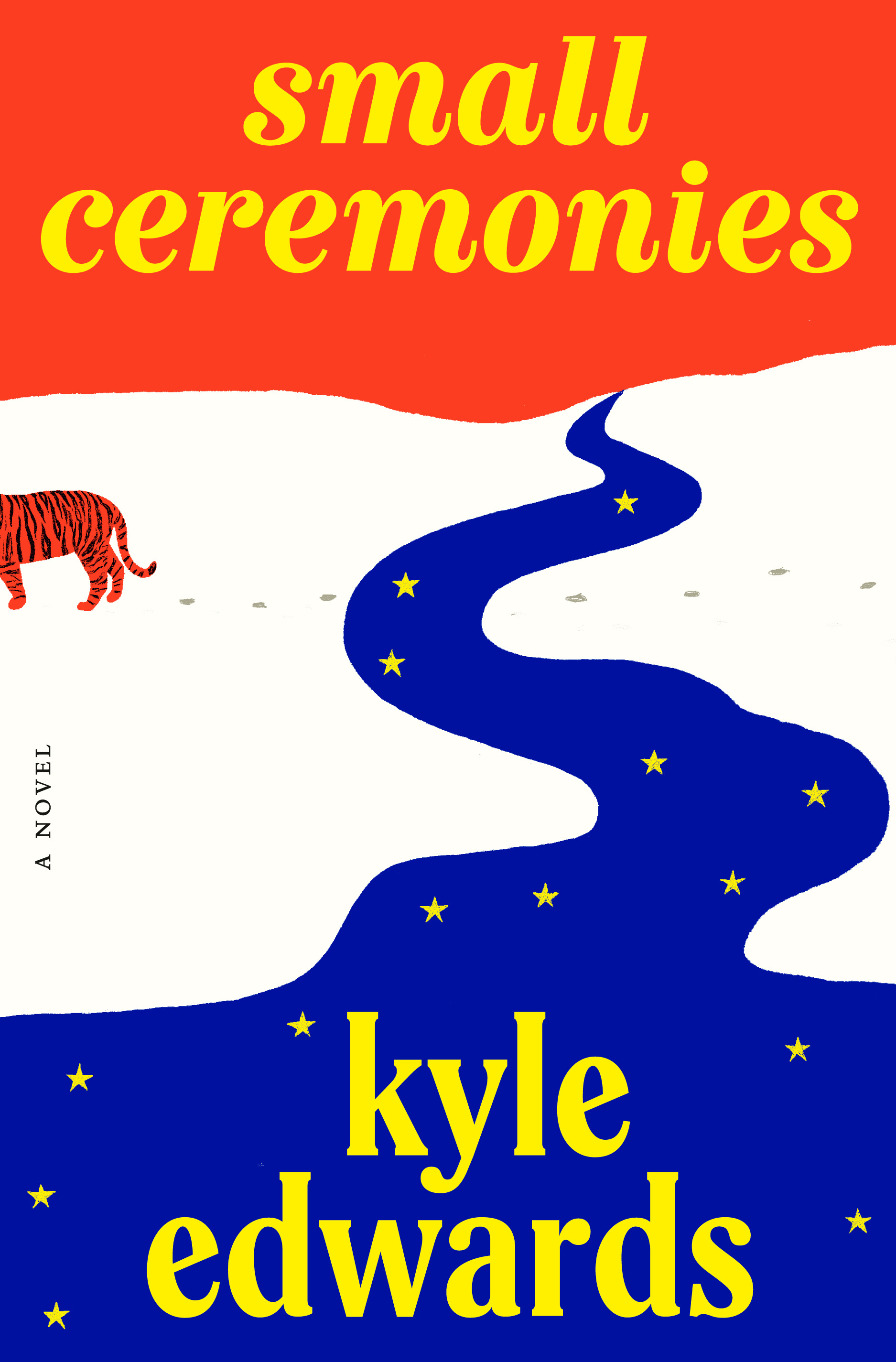
Small Ceremonies

Kyle Edwards

Although this novel has multiple narrators, the story centres around two characters; Tommy Shields and Clinton Whiteway. Tommy and Clinton, like many of us, play for the St. Croix Tigers, an inner-city hockey team in Winnipeg. The Tigers haven’t won a game in so long they are rumoured to be cursed. The novel follows Tommy and Clinton as they navigate their final year of high school and what their future may entail. Both characters have tremendous obstacles to face, whether it be a mentally ill mother or a convict brother intent on recruiting his younger brother for the drug trade. 

Edwards centres his novel around hockey and the Tigers’ degree of success. At the end of each section, we get a chapter in italics written from the point of view of a hockey commentator. Each of these nail-biting chapters presents the Tigers’ potential gains and heartbreaking losses, symbolic of the gains and losses of our two main characters.

The accuracy of detail in Edwards’s writing is astonishing. He brilliantly describes “small town” (even though it’s Winnipeg) hockey culture, from the locker room to the history of the Zamboni driver to the make-up of the fans in the bleachers. Edwards is also gifted in creating nostalgia, meeting your childhood best friend, for example, and playing marbles on the playground.

This novel humorously yet heartbreakingly describes the Indigenous experience in Canada, and the reader really does hold both Tommy and Clinton close to their hearts as we follow them on their journey of self-discovery.

It is a wonderful and effective mentor text, not only for the themes of coming of age, identity and place, overcoming trauma, racism, and friendship, but also brilliantly written. Edwards’s writing would be very effective for teaching descriptive writing, character development, setting, developing the setting as a character in itself, organizing a story atmosphere and tone, and dialect.

Trigger warnings: childhood trauma, intergenerational abuse, mental health, substance abuse, racism. 

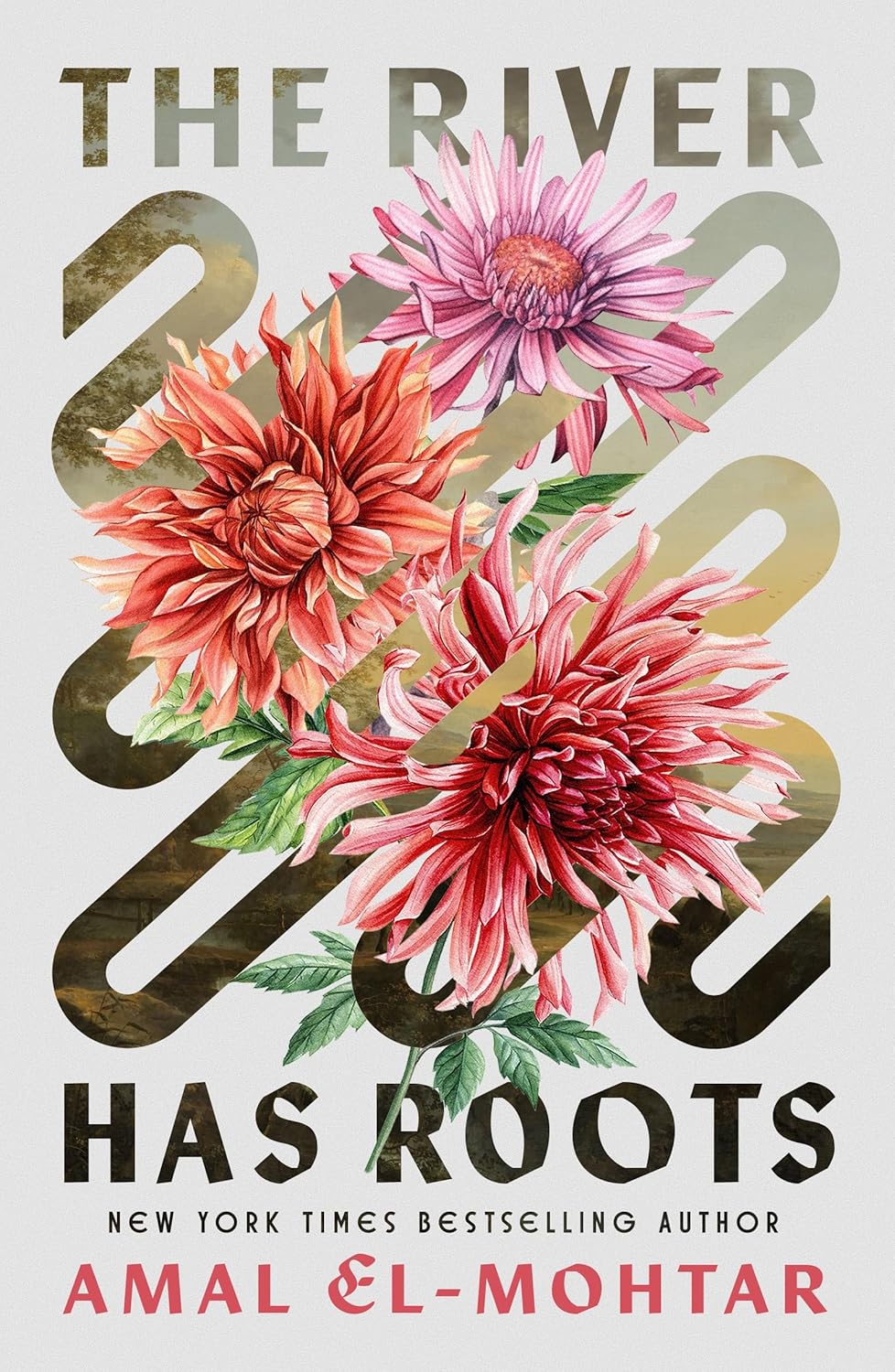
The River Has Roots

by Amal El-Mohtar

“There was a time when grammar was wild-when it shifted shapes and unleashed new forms out of old. Grammar like gramarye, like grimoire. What is magic but a change in the word…but that is the nature of grammar-it is always tense, like an instrument, aching for release, longing to transform present into past into future into will. (pg. 1-3)

The Hawthorn sisters, Esther and Ysabel, live in the small village of Thistleford located on the edge of “the beautiful county of Acadia, the beautiful land- the land beyond; antiquity”  in other words, the beautiful land of Faerie. The sisters have 2  jobs: the first is to weave beautiful willow baskets, and the second most important is to sing to the willows. You see, “when they sang together, you could feel grammar in the air”. Ester, the eldest, is being pursued by the bachelor Mr. Pollard, who “always had the beseeching expression of a whining dog; his hand, bafflingly, were always somehow both cold and moist”…needless to say, Esther is in no way interested. Instead, her heart belongs to Rin (a beautiful nonbinary character). Rin is Fae; Rin is beautiful, loving, brave, and adoring. However, Ester is in a dilemma; although she loves Rin, she vows to never break the bond she has with her sister Ysabel. She loves her sister beyond life itself, and their bond is intricately woven together, not just because they are sisters but because of the magical bond created by the grammar when they sing.

When a violent incident occurs and tragedy strikes, Esther has to choose between living in the world of Faerie with her love and staying in human form or living in the land of humans in the form of a swan. Will the bond between the sisters survive the conflict that ensues? 

This novel is a treasure trove for literary analysis. Its symbols, including the river Liss, the Willows, Mr Pollard, and the land of Faerie, are rich and complex, offering ample material for exploration. The novel’s prose, too, is a delight, best savored when read slowly and contemplatively, much like a piece of poetic verse.

This novel is also beautifully published, interspersed with what looks like linocut artwork by artist Kathleen Neeley, enchanting and folkloric.

If you loved How To Lose the Time War, co-written by El-Mohtar you love this novel.

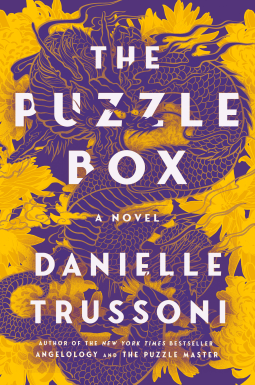
The Puzzle Box

by Danielle Trussoni

The first Trussoni book I read was Angelology…if you haven’t read it, you should. Since then, Trussoni has written a number of books, one of which was The Puzzle Master, where our protagonist is Mike Brink, a fascinating character with ‘acquired savant syndrome. You see since Mike suffered a traumatic brain injury whilst playing football, he’s been able to create and solve intricate puzzles. He sees and, at times, feels patterns and solutions to the most complex and compelling puzzles. In the novel The Puzzle Box, Mike is challenged by Japan’s Imperial Family to open the infamous Dragon Box. But solving this puzzle is more than problematic. It’s deadly. Scores of individuals have died attempting. 

This novel is great fun. I find the character of Mike Brink fascinating; he is brilliant, socially awkward, and silently lonely, and it is hard for someone to understand him and his gift. The premise and plot of this book are highly engaging, and you will have read it in its entirety in a day.

Thank you to Netgalley and Random House for the free copy.

Swan

By Sisdura Ludwig

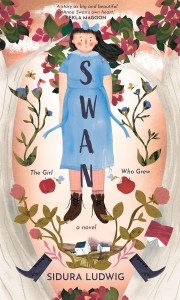
What drew me first to this book was its cover. What a beautiful, whimsical piece of folk art. What drew me second was the fact that it is a novel in verse. I absolutely adore a novel in verse, especially for middle and high school students.
Swan is a poignant true story about a 12-year-old girl named Anna. Born in 1858 in Millbrook, Colchester County, Nova Scotia, Anna was different from other girls; in fact, Anna was different from EVERYONE. You see, Anna is significant, not just big, but giant. At twelve, she is 6 feet 10 inches tall and is considered a wonder by everyone from the neighbour to the shoe pedlar. 
But Anna doesn’t want to be a wonder. She wants to be a regular girl with pretty shoes. 
As she ages, Anna discovers a way to use her peculiar size to help her family and figures. If everyone is going to look and stare at her anyway, she might as well make money to support her family, so she joins the circus as a “curiosity’.
Ludwig is a beautiful writer. Her word choice and lyricism are charming and sincere. Swan will serve as an invaluable mentor text in junior and senior high, showcasing the power of language and storytelling. Some examples of her beautiful writing are;
“I don’t know why 
God made the ground
So far from my head.”
“If God created a perfect world 
In only seven days
Why don’t I fit anywhere?”
What a fantastic discussion you could have around these two quotes alone!

Thank you to Netgalley and Nimbus Publishing for the free copy.

I Who Have Never Known Men

by Jacqueline Harpman

I Who Have Never Known Men is an apocalyptic novel about the end of man and womankind.
The unnamed narrator only knows one world: a prison with 39 other women hidden in an underground cave. She is the only child in the group and has no recollection of what the world was like before their imprisonment. We never know why these women are in prison; we only know that a political event led to the imprisonment of all women with men as guards.   If you liked the series Wool by Hugh Howey or have an attachment to Plato’s Republic, you will appreciate this story.
Something happens (we never know what) where the women are suddenly and surprisingly released and are faced with freedom.
This novel made me feel overwhelmingly sad. I thought it was all about loneliness and isolation. But then I thought about it and talked about it, and I came to realize that it really is a story of survival and resilience. Our narrator lived a life of agency and made decisions truly on her own.
This novel would make a solid addition to a High School reading list as it lends itself to wonderful discussion on theme and author choice.

I Am Wind: An Autobiography

written by Rachel Poliquin illustrated by Rachel Wada

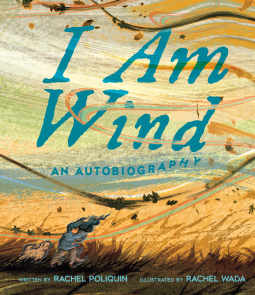
This book is BEAUTIFUL. Poetry, science, culture, folklore, history artwork. This book is a perfect example of how to use a multitude of genres to teach a concept.  A quintessential hybrid text. 

First of all, Wind is personified. It is the main character of the text. Wind tells us their story through poetry:” I Am Wind/I whistle. I howl/I’ll steal your hat, your house, your kitten, your kite/ I whisper whisper whisper secrets in the leaves…I am the Great Rushing in All Directions” (Poliquin). Wind is portrayed as a beautiful, gentle friend and destructive enemy. 

Wind also tells us their story through history with little “Wind Chronicles,” which describe types of winds in various cultures and record historical events of destruction and peril caused by tornados and storms.

Wind also charmingly tells of its characteristics directly (as if in an extended character sketch): how it is created, the types of wind forces, how man has harnessed Wind for its own uses (sailing, wind farms), how it is perceived in mythology, and its multitude of names in various cultures.

Throughout all of this wonderful poetry, prose, and information are the most beautiful paintings in the most vibrant colours. A multitude of lessons could be created from the artwork alone.

For educators and families with young children, I am Wind: An Autobiography is a delightful addition to your library. It’s not just informative; it’s engaging and absolutely beautiful. This book will captivate your little ones, making learning a fun and interactive experience.

…oh and the book creators live in British Columbia so we’ve got some Canadian content AND indigenous content (this always makes me happy).
I will be recommending this book to every teacher I know!

I will definitely be recommending this book to every teacher I know!!

You will be able to own this book November 5, 2024

Thank you to NetGalley and Penguin Random House for the free copy.

Lake of Souls

Ann Leckie

Ann Leckie is a brilliant author. Science Fiction isn’t usually my genre of choice; however, some of my favourite books are Sci-Fic, so I’m not sure why I don’t choose it more often. Maybe because I didn’t have access to ANYTHING sci-fi as a child???. In this particular anthology, there are newer stories Leckie has written and stories set in the world of The Raven Tower novel. I have chosen to comment on a few of the stories that sit outside the world of the Raven Tower. The Novela Lake of Souls is one of these. As a narrative, it has SO many layers: world-building, exciting development, and a variety of deep themes of identity through place and family adventure, imagination, and curiosity, all of which would instigate and feed thought and discussion. 

The anthology features a diverse range of stories. Another Word for World explores the importance of communication, especially in power dynamics and across generations. The Justified serves as a mentor text for political sci-fi with dystopian elements. The VERY short tale, Footprints , is a creepy atmospheric tale about a potentially human little girl and her malevolent ‘toy’ bear (great for teaching atmosphere and indeterminant ending).Each story offers a unique reading experience, showcasing Leckie’s versatility as an author.

This anthology of Ann Leckie’s works is not just a collection of entertaining stories that can be used as a suitable resource for study in a high school English class. Leckie’s mastery of storytelling and her beautiful gift of prose makes her works engaging. Moreover, her skill as a world-builder, particularly in science fiction, adds an educational dimension to her stories, making them credible for academic study. 

Thank you to Orbit Books and Netgalley for the free copy.

The Pole

by J. M Coetzee


It’s taken me a while to write a review for this novel. How do I write an objective review about a story I so significantly identify? The Pole is a love story but not a love story. It is a story about friendship, but not much of a friendship. In this novel, Coetzee does what Coetzee does best, with razor-sharp precision; he concisely writes what we all have felt and, in this case, what a middle-aged woman feels when she meets someone who tells her: “She gives him peace. She gives him joy”. (pg. 32)

Beatriz is nearing 50 and is a mother and a wife. She is content in life, “an intelligent person but not reflective [however] a portion of her intelligence consists of an awareness that excess reflection can paralyze the will.” (pg 4).
Witold Walczykiezicz is a 70-year-old Polish pianist known for interpreting Chopin’s works. When he arrives in Barcelona to perform, he meets Beatriz, a socialite who seems forced to be a hostess during his visit. Witold immediately falls in love with Beatriz, claiming that she is Beatrice to his Dante.
But Beatriz is anything but attracted to Witold. In fact, she has “emerged from her explorations with no great respect for men and their appetites, no wish to have a wave of male passion splash over her” (pg 27).
But something about Witold compels Beatriz to join this strange musician’s world, but will it be as a friend or a lover?

This novel, with its unique structure that resembles a narrative poem, is a captivating read. I was initially provided a free digital copy from Netgally and the publisher, but I was so enthralled that I ended up purchasing a hard copy. I am certain to revisit it, or at least reread portions of it, in the future.

While the main characters of this novel may be middle-aged and elderly, their experiences and responses are deeply human, making them relatable to readers of all ages. The beauty of the prose and the depth of the sentences serve as expert examples of author craft, inviting readers to delve into the intricacies of the narrative.