
by Daniel Kraus
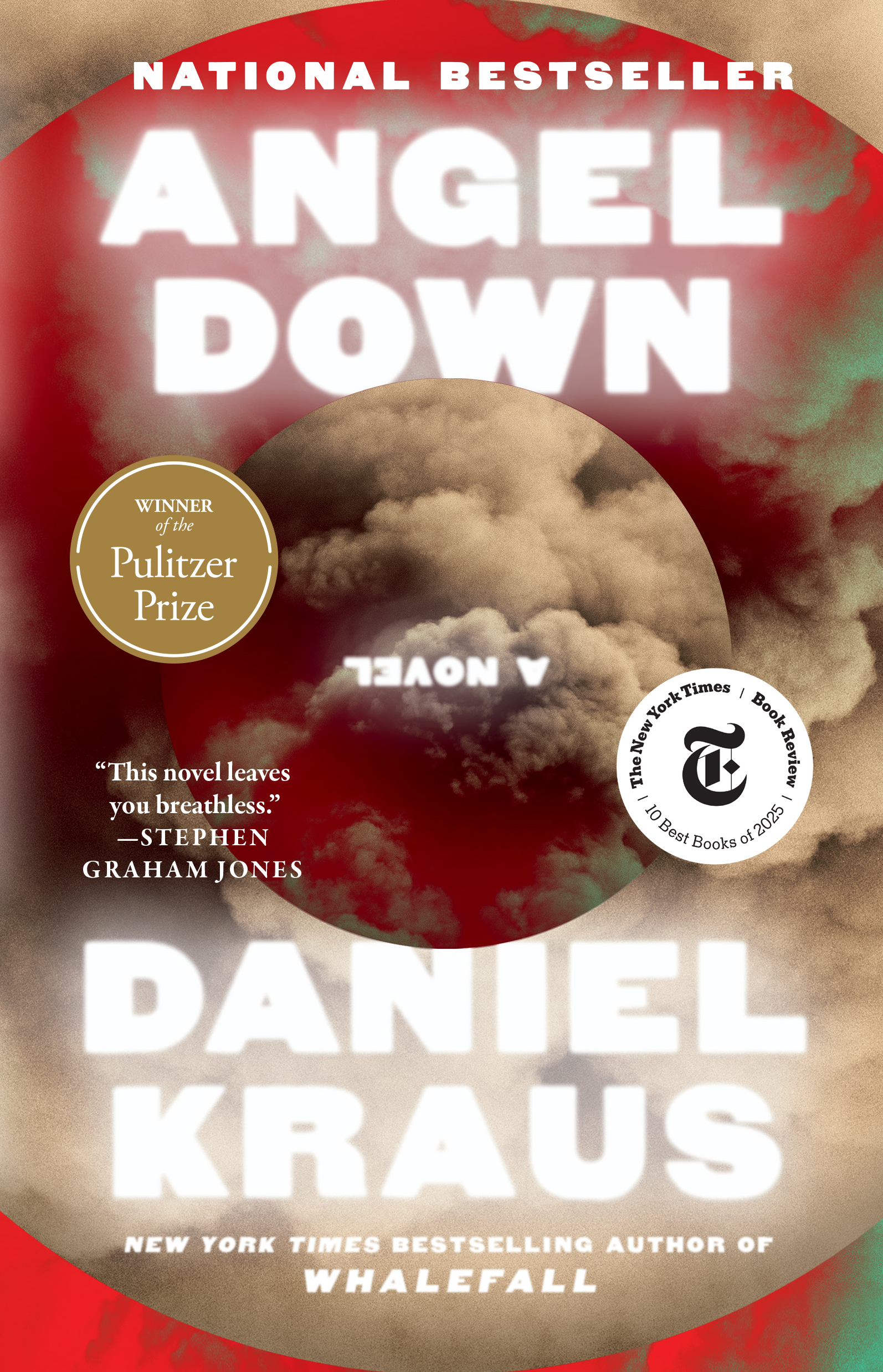
I read Daniel Kraus’s Whale Fall years ago and absolutely loved the story, writing style, and themes, so when I learned of Angel Fall, I immediately bought it. Well, I had to order it because no bookstore near me carried it. But it sat on my bookshelf for months, and when I heard it had just won this year’s Pulitzer Prize, I decided it was now the time to read it. And you know what? My copy has a plethora of sticky tabs and annotations throughout. It’s not a quick read, or at least it wasn’t for me. There were so many profound themes, beautiful phrases, and places in the text that I want to revisit in the future.
The novel is set in France during World War I and follows Cyril Bagger, the son of a bishop whose personality is such that he is somewhat of a con artist, let’s just say he’s not fighting in the war for the sake of freedom. Despite his ideology, or lack thereof, Cyril serves as a Private First Class in the army, with the official duty of a grave digger. Early in the story, Cyril and four other soldiers are sent to investigate mysterious shrieks coming from the trenches because, as they are told, “the army does not leave a man behind” (pg. 41).
When Cyril and Arno, a fourteen-year-old soldier who lied about his age to enlist, attempt to cross No Man’s Land, they discover an angel trapped in barbed wire. They free her and carry her to safety. The angel has a mysterious quality—her radiant appearance is veiled under a cloak, and anyone who sees her perceives their deepest desire: for some, she appears as a missing loved one to others, a path to fortune. The soldiers who accompanied Cyril want to possess the angel for their own gain, but Cyril does not. The angel tells him, “You are the only one to ask nothing of me” (pg. 189).
The novel is a heavy read. Not that it’s sloggy or difficult, but it is very visceral in its depiction of war and prompts the reader to search their own heart for a personal understanding of humanity, especially during a time of conflict. It is also written as a continuous sentence (although I did find punctuation a very few times). In fact, Kraus writes, “like the carnage won’t ever end, it’s a sentence in a book careening without periods, gasping with too many commas, a sentence that, once begun, can’t ever be stopped, a sentence doomed to loop back in on itself to form a terrible black wheel that, sooner or later. Will drag each and every person to their grave” (pg 6). And the writing style does, indeed, create a tone of unending dread with the feeling of horrific monotony. The novel is also rich in symbols: the angel, the novel The Count of Monte Cristo, and the Bible, just to name a few. It is a novel worthy of the Pulitzer as it is a sobering story of not only the physical and psychological horrors of war, but also the potential moral ambiguity that comes with killing for an ideal. It is a discussion of theology, philosophy, morality, politics, and history. It is also, in a way, an examination of conscience…so yes, as I said, it is heavy.
Because of Kraus’s beautiful writing and the thought-provoking themes, Angel Down lingered in my mind for weeks after I finished reading, making it one of my most memorable books of the year thus far.

