A Rip Through Time by Kelley Armstrong


I love Kelley Armstrong. My favourite Series of her’s is the Cainsville Series.” I started the first one, Omens, and then proceeded to stay awake all night reading it. There are 5 titles in this Series if you’re interested.
Armstrong’s newest novel is A Rip Through Time which sets us up for a whole new series; this one is about serial killers and time travel. HOW FUN DOES THIS SOUND!
Mallory, our heroine, is a homicide detective from Vancouver. She is in Edinburgh, Scotland, to be with her dying grandmother. While on an evening run she hears a scream and goes to investigate just to be knocked unconscious. She then wakes up in the year 1869, inhabiting the body of a young housemaid named Catriona. Mallory soon discovers that Catriona was strangled in the same alley more than a century before Mallory was attacked.
Mallory now takes it upon herself to solve Catriona’s murder, all the while trying to figure out how to get back to her own time and place in history.
My favouite thing about Armstrong’s writing, besides the incredibly imaginative and entertaining plot, is the voice of her protagonists. The first-person narration presents Mallory as a funny best friend relaying a crazy story over a bottle of whiskey. But, of course, the more you drink the crazier the story becomes, and you laugh and laugh and laugh until your belly aches.

A Rip Through Time will not be published until June 2022 making it the perfect addition to your summer reading list.

The Dictionary of Lost Words by Pip Williams

I’m a nerd. I love books. I especially love books about books, libraries, and words. I also gravitate towards feminist literature. Lucky for me, The Dictionary of Lost Words is a wonderful combination of both.
Our protagonist Esme loves words as well, probably because she spends her childhood under the table in the scriptorium where her father works compiling words and definitions for the Oxford English Dictionary. While there, little treasures in the form of words accidentally fall from the table, and she reverently gathers them up and keeps them safe. However, as she gets older, Esme notices that other words are carelessly left and that these words tend to be more relevant to the world of women. So Esme takes it upon herself to collect as many words as she can so that she can build a dictionary that will acknowledge and preserve these words.
I love Esme. She is curious and brave and so, so smart. I love the relationship he has with her father; for a man who works with words, he can find no word appropriate enough to express the love he has for Esme.
I fell into this story immediately. William’s vividly transported me back in history, where I viewed a world from the shoulder of a fictional character whose story was inspired by true events. What a wonderful place to experience history!

2021-2022 Book Club Titles

I’m interested to know how other people are running book clubs during Covid. Is Zoom the “go to” platform for most?  Or is there some other more intimate way to connect with our book people?

In September we had the opportunity to host book club in person for the first time in close to two years. Joy was palpable and we were so excited to see each other in person. Sadly we haven’t been able to meet in person since the arrival of Omnicron (sounds like some interstellar visitation whose sole purpose is to poop on everyone’s parade). Anyway, September’s meeting was  the “first” book club of the season, the one where we share book suggestions and vote on the titles for the year and this year we have some wonderfully diverse genres:

Empire of the Wild by Cherie Dimaline

The Seven Deaths of Evelyn Hard Castle by Stuart

The Madness of Crowds by Louise Penny

Daughters of Kobani Gale Tzemarch Lemmon

A Ghost in the Throat by Doireann Ni Ghriofa

From the Ashes Jessie Thistle

Dark Archives by Megan Rosenbloom

All’s Well Mona Awad

The Book of Longings Sue Monk Kidd

The Dictionary of Lost Words by Pip Williams

What books are you reading together this year?

“Shuggie Bain” a novel by Douglas Stuart

      This is a sad, frustrating, yet compassionate story. In this book, is the main villain (I was going to write "antagonist", but villain is more appropriate) is alcohol that seduces and creates monstrous behaviour sympathetic characters.
      Although Agnes seems to be the main character, this is Shuggie's story. He is our anti-hero. For most of the story, Shuggie is a child trying to survive the hardships of poverty in Glasgow without an adult's guidance to help. It is Shuggie who has to take care of his alcoholic mother once his father abandons the family for another woman.
     Agnes is both beautiful and ugly. She leaves her first husband, "The Catholic", the father of her first two children, to marry a taxi driver by the name of Hugh Bain and soon after gives birth to Shuggie.
     I felt NO sympathy for Agnes for most of the book; I thought it was her vanity more than her addiction that led to her make the stupid, selfish decisions that jeopardized her life and the life of her children…until I came across this quote "She loved [Hugh], and he had needed to break her completely to leave her for good. Agnes Bain was too rare a thing to let someone else love. It would do to leave pieces of her for another man to collect and repair later." To me, the cruelty and selfishness of Hugh outweighed Agnes's weakness.
     Like I mentioned earlier, though, this is Shuggie's story. His heartbreak over his mother, his father's treatment, and his confusion about his sexuality make him a genuinely sympathetic character.

I thought about Shuggie long after I finished reading.

All Things Cease to Appear by Elizabeth Brundage

Over the last year, I have been attracted to gothic mysteries and crime novels. Sometimes I google the genres I’m interested in to see what pops up on the screen. So when I typed “mystery gothic crime novels”, Elizabeth Brundage’s novel came up.
What I thought would be an easy, quick, pulp fiction read turned out to be one that was so incredibly well written. I immediately made Brundage my new favourite author.
The novel starts off with the central crime, a gruesome murder of a young mother (not a spoiler; it happens in the first chapter). The story then proceeds to flashback to introduce and develop the characters directly and indirectly affected by her death.
The little town of “Chosen” has 2 types of residents: those who have always lived there struggling to make a living from a depressive economy filled with bankruptcy and alcoholism, and those with money and education who have moved to Chosen to because of its proximity to the neighbouring university. Needless to say, this diversity leads to all sorts of interesting interactions between residents.
As with most good stories, I loved some of the characters and hated others. Even though the story is centred around the actions of a psychopath, it is also a story about family, strength and redemption.
This novel is definitely one of my favourite of the year so far.

D (A Tale of Two Worlds)

by Michel Faber

Apparently, this novel was written to commemorate the 150th anniversary of the death of Charles Dickens. . As such, Michel Faber wonderfully inserts little allusions to various novels written by Dickens.  (ie. Beak House, Magwhich) If you’re looking for a good read-aloud for junior high D (A Tale of Two Worlds) is absolutely delightful and you don’t have read any novels by Charles Dickens to enjoy this novel.

Our main character,  Dhikilo, is originally from Somaliland. She does not know her birth parents and was adopted by an English couple. Dhikilo has friends, but she has never felt she belonged. It could have been because of the colour of her skin, It could have been because she was adopted, and it could have been because of the uniqueness of her name.

One day all the “ds” begin to disappear from the world. She noticed the missing Ds first from the newspaper her father is reading then next from her mother’s speech. On her way to school, she notices Ds missing from all the signs, from all the books, and from all conversation. During this confusing time of D’s disappearance, Dhikilo’s favourite teacher, Professor Dodderfield, dies and she feels compelled to go to the funeral…..but she discovers this teacher isn’t really dead! Instead, Professor Dodderfield sends her to a magical world Liminus (with his Dog Mrs Robinson who turns into a sphinx at a whim) to stop the disappearance of the Ds.

From here on in Dhikilo and Mrs. Robinson encounter a variety of interesting characters and creatures on their way to confront the Great Gamp who seems to be the one who is stealing all the Ds by using glittering dragonflies.

“one careless insect lost its grip and the shining piece fell to the ground…it was already dissolving into the snow but it stilled glowed. Dhikilo knelt down.. and touched the disintegrating D with her bare fingertips. Immediately, she had a vivid mental picture-like a film projected straight into her brain- of a camel. A camel with one hump. A dromedary. Then the D shriveled into nothing and the vision of the dromedary faded from her imagination” pg 104. 

This is a wonderful novel the teach descriptive writing (the Magwitches with long dirty straggly hair the colour of the stuff you take out of the vacuum cleaner” 107-108)

It is also a novel that can be used to discuss the themes of prejudice, strength, family, courage and friendship.

So if you are looking for a fantasy novel to read D (a Tale of Two Worlds) is a short, easily accessible and highly entertaining novel to chose.

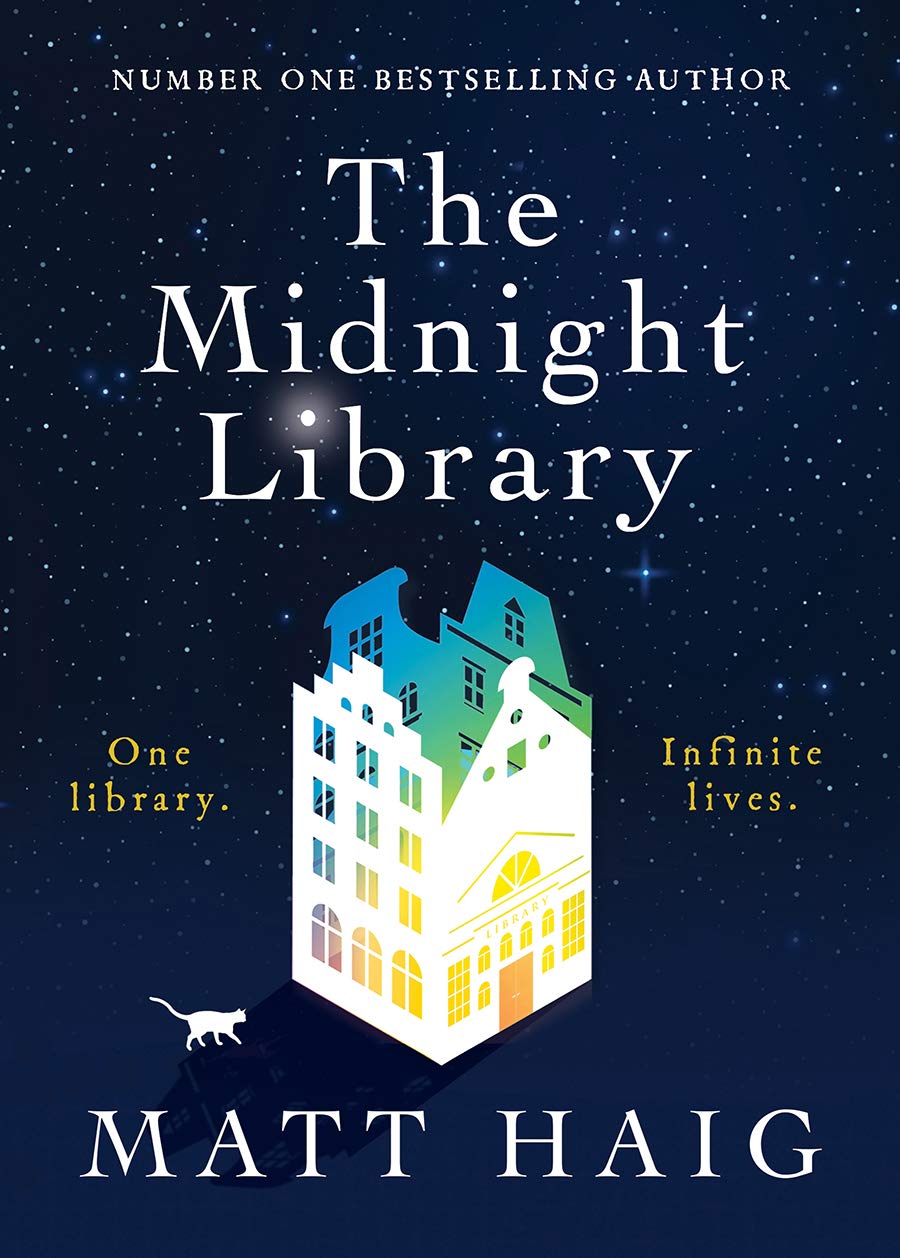
The Midnight Library by Matt Haig

Ok, I’ve read a lot lately about Matt Haig’s books. I’ve meant to increase my exposure to speculative fiction, and Haig’s books seem as good a place to start. If you look on Goodreads, almost all of his books have a 4+ star rating (not that Goodreads ratings matter. Ok, Goodreads reviews may gently nudge me towards a title or two). Haig’s premises to me, seem deeply philosophical, and I love books that make me think. So I finally picked up one of his titles, his newest The Midnight Library. And yes, it did make me think.
Our anti-hero Nora has had a REALLY bad day. Her cat died, she lost her job, and no one is responding to her texts. So Nora decides to die. No, I did not just spoil the plot…the first sentence literally says so.
Because of a choice she makes, Nora finds herself in the Midnight Library, a sort of purgatorial holding place where she is forced to consult a “book of regrets” and then choose from books that hold all the choices she could have made in life. Once she opens a “book of choice” she is transported to that life where she experiences what “could have been”.
I don’t know about you, but I’ve often thought about “what could have been if I’d only…”
Which undoubtedly is a wasteful use of time. This novel reminds me of this waste. I really appreciated the slow and steady character growth Nora exhibits. An example is her view of loneliness. On page 5 Nora states “all though she’d studied enough existential philosophy to believe loneliness was a fundamental part of being human in an essentially meaningless universe”, but by page 120 this view has changed to “amid pure nature solitude took on a different character. It became in itself a kind of connection. A connection between herself and the world. Between her and herself.” Loneliness vs solitude. HUGE paradigm shift. One, we all must make at least once in our life. I’m not going to tell you Nora’s perception of “loneliness” at the end of the book, but you can probably surmise what it will be.
Even though this book is philosophical, it is extremely accessible. It was a perfect “deep” read during a time in our history where I find reading deeply difficult.
It’s a good book! Read it!