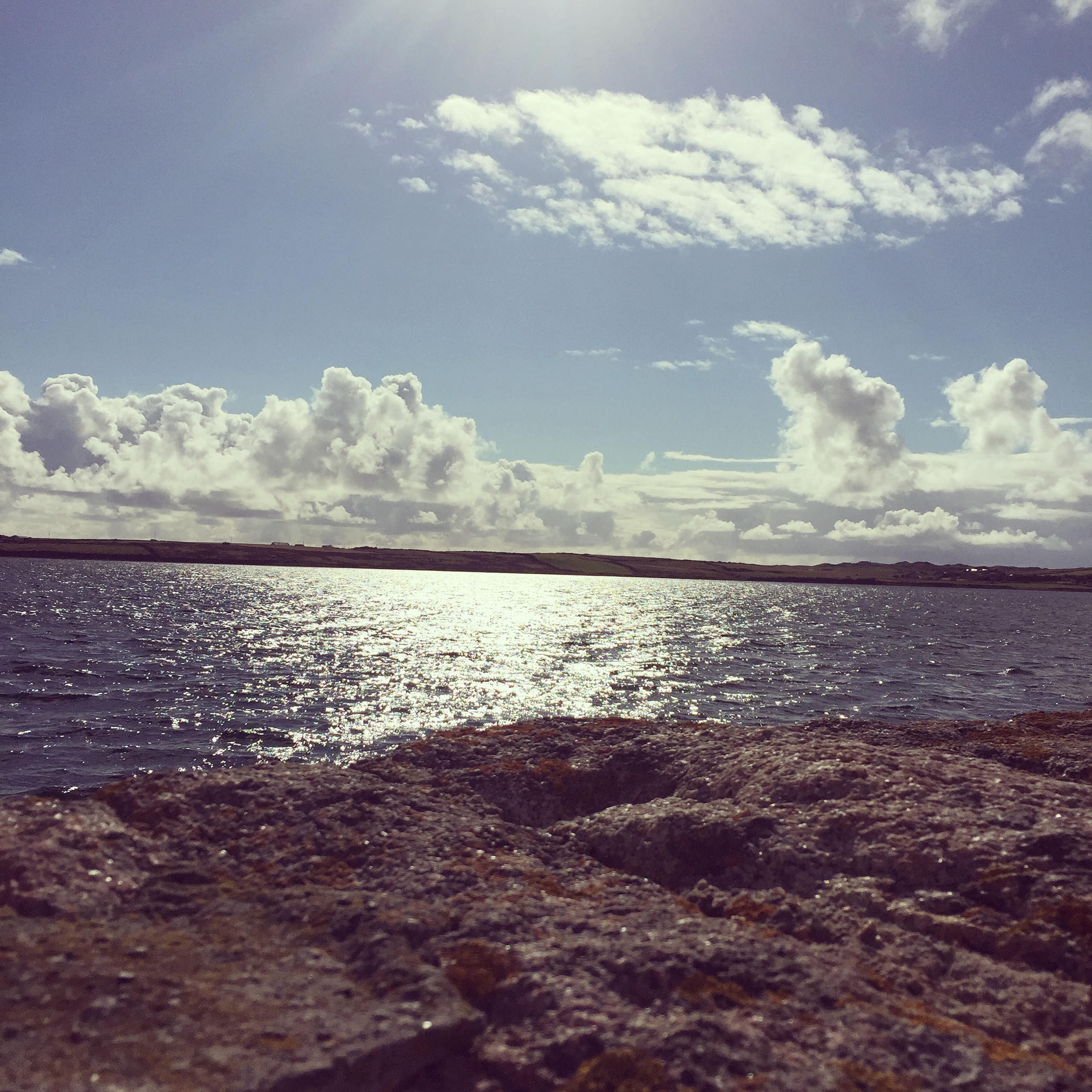
Purging in Purgatory

You know that place you sometimes go where you feel all itchy and unsettled inside. Like you don’t know if you should go out and run a mile

or just sit down on the floor in a puddle and try to cry?

You’re feeling something but you can’t quite name it? You’re not happy, you’re not sad, but somewhere in between and it’s definitely not content. You’re just feeling displaced and well,

feeling as though you’re visiting purgatory.

I visit the purgatory, in no way under my own volition, whenever get a little stressed or feel slightly out of control. And when I’m here, I feel the need to clean my house. To be the mistress of my domain. Participate in something, even if it’s something as insignificant as washing my kitchen floor, and feel as though I’ve facilitated change.

Accomplished something tangible.

Completed a task.

Success I can see.

When I linger in this purgatorial emotional space for a bit longer than usual, I start purging. But unlike Dante’s purgatory where time is spent purging sin, I purge articles and objects I’ve accumulated. I toss out plants that annoy me for needing more than water to survive. I pack up and donate clothing to the Salvation army (in one purging zeal, when I concluded that I had far too many black boots, I threw out several pairs, unintentionally including an expensive pair I had bought a month before…Now I’m a more discerning purger).

I will determine who, er I mean what will stay and what will stay within the walls of my sanctuary and what will go.

Today, frighteningly enough, I even tippy-toed my fingers through my three bookcases in an attempt to weed my library (almost two-hundred volumes) settling on only two that I could part with. So I must not be too far past the threshold of purgatory to feel compelled to part with my beloved books.

Fortunately (unfortunately?) I don’t visit this “purgatory” very often. At least not often enough to keep on top of a collection of shoes and magazines and club soda cans that accumulate at a rapid rate in my home.

But when I do, the mindless organizing

and tossing

and cleaning

takes my mind off the unsettledness inside and as an end result I have a spotless abode free of some clutter,

and a mind blessedly free of a bit of clutter as well

if only for a little while.

Shards of Bare Mute Blackness

I keep journals.  Journals possessing emotional streams of consciousness.  Travel journals.  Journals that read as an itemization of my day.  Journals with ideas and impressions from anything and everything.  But I also have a journal filled with quotes. Quotes from novels.  Lines from poems.  Dialogue from movies.  Chains of words I find especially poignant and sometimes beautiful in their conciseness or imagery.  One such quote comes from Brian Morton’s novel Starting Out in the Evening:

The world, the human world, is bound together not by protons and electrons, but by stories.  Nothing has meaning in itself:  all the objects in the world would be shards of bare mute blackness, spinning wildly out of orbit, if we didn’t bind them together with stories.  – Brian Morton

Stories are inextricably a human thing. We are entertained by them. We are lulled to sleep by them.  From them we not only learn about others, but more importantly we learn about ourselves.

Living a life that serves as a basis for our own stories.

My fear is that young people are indifferently coasting through life with no stories of their own to tell.  That families aren’t sharing anecdotes about growing up.  That there are no more tales starting with  “when I was your age” told around the supper table:

“What did you do today young man?”

“I dunno.  Played my video game.”

“What else did you do?”

“Nothin”.

“Nothing?  You must have done something else.”

“I dunno.  I can’t remember”.

What if we looked at each day as a story to be told?  Would the sky be bluer?  Would the people we work with be more interesting to behold?  Would what we say be more scintillating?

Everyone should go someplace somewhere all alone if only for a day.  Someplace new. Someplace never before seen by your eyes.  To discover and meet and smell and taste a new environment.

Be a new character in a new setting.  With a wide-eyed curiosity that is stronger than insecurity and indifference.

To take bits and pieces of information.  Data colored by emotion.

A life’s tapestry that is more than a history.

And string them all together

to form something

exclusively our own.

Corpora vs Spiritus

“The day of the corpora is the night for the spiritus.  When the bodies cease their labour the spirits in man begin their work.  The waking of the body is the sleep of the spirit and the spirit’s sleep a waking for the body.”  (Paracelsus cited in Lawrence Durrell’s “Justine”)

Well, this explains why I’m so tired some mornings.  My body may be at rest but my spirit is partying it up with the other spirits!

I find this passage fascinating.  If you only knew where your spirit goes when your body is recharging throughout the wee hours of the morning.  Does it soar in and out of the earth’s ether touching down only at places it’s never visited before like select iridescent cells of the Brazilian rain forest or the Monet-esque sunflower fields of Provence.  Or does it meet the spirits of others have also left their “corpora”, those we never see, those far away, those who have died?

A way to bridge distances if only with your imagination.

I also find it intriguing that the quote mentions that the spirit has “work” to do.  Could this mean righting wrongs, healing hurts, strengthening my own sense of spirituality with my God?  We are taught to say prayers before we go to sleep.  A preparation, perhaps, of a deeper communion with God.

If during the night, while we are asleep, our body healing and resting from the day in order to work to the best of its capacity when conscious it only goes to say that we should also take time out, even if it is at night, to restore and strengthen our spirit.

Maybe our spirits too have places to go, people to see, things to do.

If our spirits cross paths in the night be sure to wave “hello”!

The Invisible Life of Addie LaRue

Adaline lives in 17th century France with 17th-century societal expectations- she must marry. Now Addie doesn’t want to get married. She wants to travel and learn and meet new people. She definitely doesn’t want to keep a home and have babies. So she does the only thing she can do to get out and makes a deal with the devil. Being a master equivocator, the devil distorts the bargain, yes, she will be free to travel and learn and meet new people however she will be immortal, and tragically be immediately forgotten by anyone and everyone she meets, making it impossible to forge any relationship whatsoever. Addie truly becomes invisible and must maneuver through the centuries on her wit and with only her own company. Sure the devil pops in every year or so to bully her, and as anyone would, accepts his company because, of course, he is the only “friend” she has. 

Until …

one day she enters a book store where she is remembered. Now what? What will the devil do with these new sets of circumstances? Or is the devil himself who has placed this “person who remembers” in her path just to taunt and torture her.

I really loved this book. It reminded me of other novels where our protagonist is immortal and weaves his/her way through the centuries. Pilgrim by Timothy Findley and Orlando by Virginia Wolfe come to mind. However I found this novel much easier to consume- in fact, I read it in just over a day.

Philosophy, history, romance, fantasy, all included within the pages of this book along with several loving tributes to art and literature make this novel one of my favourites of the year. 

I was given a free copy of this novel by NetGalley and MacMillian-Tor books (thank you!) but I will most certainly be purchasing one for my bookshelf. It will be work a re-read in the future.

Delicates

Delicates is the second in a graphic novel series by Breena Thummler. Where the first novel Sheets introduces us to Marjorie Glatt’s story and her story, Delicates continues her story but also introduces us to a new character Eliza Dunn.

At the beginning of Delicates, Marjorie is still coming to terms with her mother’s death with the support of her ghost friend Wendell. Marjorie has started eighth grade and is now struggling to be part of the “popular” group who seems to be behaving like a typical group of obnoxious “judgey” teenagers. The ghost Wendell sees these friends for who they truly are and often calls Marjorie on her association with these newfound friends. And if truth be told, Wendell is feeling a little bit neglected.

Where Marjorie was the main character in Sheets, in Delicates she shares the page with Eliza Dunn, a classmate who is bullied because of her social awkwardness, and her peculiar preoccupation with photography, particularly photographing ghosts. 

Marjorie’s and Eliza’s lives soon become intertwined largely in part because of Wendell’s involvement. To Marjorie’s surprise, Eliza can also see Wendell. 

Along with a hugely emotive story, the artwork (especially the colour choices) are really quite beautiful. The story itself is a timely one, friendship, and acceptance, and the strength it takes to recognize and proactively stop bullying.

I would add both Sheets and Delicates to any school or classroom library.

Thank you NetGalley and Oni press for the free copy.

A Meditation on Thornton Wilder

“There arose a perfume of tenderness, that ghost of passion which, in the most unexpected relationship, can make a whole lifetime devoted to irksome duty pass like a gracious dream” (pg. 74)

The Bridge of San Luis Rey by Thornton Wilder.

I have fallen in love with Thorton Wilder because of this quote.

How wonderful would a relationship like this be? Having to get close enough not only in physical proximity but emotional proximity as well, to one person and stay there long enough to inhale that “perfume of tenderness”

where your first instinct would be to wrap your arms around this person and hold them close.

Tenderness without forethought, without premeditation, without an agenda.

No pretension.

To be pleasantly surprised at a love that grows where you didn’t expect it to grow. And you look upon it in wonder, finding it near impossible to believe that it truly exists in you,

the most unlikely of places,

or so you believed.

Where obligation and duty never really existed in its denotative form. All business-like and astringent.

No boundaries set by written laws or verbal promises but rather

a fidelity that is unexpected and natural.

Some of us have found in our relationships some such a manifestation of Wilder’s love

and some of us are still waiting.

Whatever the case I hope we recognize it as such

and hold on to it as a dream come true,

feeling blessed.

The Midnight Library by Matt Haig

Ok, I’ve read a lot lately about Matt Haig’s books. I’ve meant to increase my exposure to speculative fiction, and Haig’s books seem as good a place to start. If you look on Goodreads, almost all of his books have a 4+ star rating (not that Goodreads ratings matter. Ok, Goodreads reviews may gently nudge me towards a title or two). Haig’s premises to me, seem deeply philosophical, and I love books that make me think. So I finally picked up one of his titles, his newest The Midnight Library. And yes, it did make me think.
Our anti-hero Nora has had a REALLY bad day. Her cat died, she lost her job, and no one is responding to her texts. So Nora decides to die. No, I did not just spoil the plot…the first sentence literally says so.
Because of a choice she makes, Nora finds herself in the Midnight Library, a sort of purgatorial holding place where she is forced to consult a “book of regrets” and then choose from books that hold all the choices she could have made in life. Once she opens a “book of choice” she is transported to that life where she experiences what “could have been”.
I don’t know about you, but I’ve often thought about “what could have been if I’d only…”
Which undoubtedly is a wasteful use of time. This novel reminds me of this waste. I really appreciated the slow and steady character growth Nora exhibits. An example is her view of loneliness. On page 5 Nora states “all though she’d studied enough existential philosophy to believe loneliness was a fundamental part of being human in an essentially meaningless universe”, but by page 120 this view has changed to “amid pure nature solitude took on a different character. It became in itself a kind of connection. A connection between herself and the world. Between her and herself.” Loneliness vs solitude. HUGE paradigm shift. One, we all must make at least once in our life. I’m not going to tell you Nora’s perception of “loneliness” at the end of the book, but you can probably surmise what it will be.
Even though this book is philosophical, it is extremely accessible. It was a perfect “deep” read during a time in our history where I find reading deeply difficult.
It’s a good book! Read it!

Covid Conundrum

I wanted to read.
But I couldn’t
I wanted to write.
But I didn’t.
I am at a time in life that is opaque, where there are no bold lines,

only shadow and shades.

So I have begun to redefine myself.


On the cusp of retirement, a time when I aspire to hone my passions and strengths (without being guided by a paycheck) I take solace in the fact that there is one thing I will always be-

a reader.


It has only been in my later years, where I have become confident enough to identify as a writer. To claim that I am one.

And as I begin to wind down in my career (after 30 years), I have full intentions to read more, and write more

and grow creatively and profoundly in voice

and in imagination.

I aspire to be the embodiment of a sentient library where those seeking stories can come and confer. Suggestions of titles would trip off my tongue like water over rock.

To read.
To write reviews.
To write short stories.
To finish that novel.And then…

A global pandemic.

Oh, I thought, now that my life is limited in both act and engagement, I will have copious amounts of time to read and write and create.

But alas, I have yet to take advantage of the circumstances in which I find myself.
Instead,

I check updates,
And outbreak patterns,
And my temperature.


My concentration is non-existent. Sadly I can scarcely focus long enough to live in another world if even for a minute.


And all of this has been heartbreakingly disconcerting.


So not only has my identity been challenged, but the one place where I used to be able to claim respite from reality has slammed the door without giving me a key.

I long to wander freely in fiction where I can think of nothing else but plot points and protagonists.

Soon.

The Sound of Lightening

We are having a bout of hot weather and lightning storms before the arrival of autumn.

I love the sound of lightning.

No, I don’t mean thunder. I don’t like thunder. It sounds ominous and threatening and downright mean.

But lightening…the flash in the distance.  The moments of silence.

The beauty without the boom.

It’s seems to be a revelation before an announcement a power has arrived.

It reminds me of little gleams of insight. Glimpses of pure truth

before the racket and fuss distracts us from the light.

How often is the truth this simple.

Backlighting the clouds

helping us to see what lies behind.

Rarely the need to cover our ears.

“Time Heals What Reason Cannot

Time heals what reason cannot. ~Seneca 

It’s interesting

how much difference a day can make.

I am continually amazed at how,

over the course of a measly twelve hours

a person can go from being mired in the deepest darkest pit of disappointment

to walking on sunshine.

This change cannot merely

be a matter of perspective.

Maybe it’s the alignment of stars?

or a shower of meteors?

or

the pull of the earths gravity with the passing of night into day?

“Time” has to play a part.

True, the passing of time wrecks havoc

but

it also creates miracles.

Time is not the erasing of memories,

but the blurring

and sanding

and softening the harshness

some memories can bring.

Patience is the key to living the cliché “this too shall pass”.

Because it does.

In the meantime you just need to remember

to breathe.

And wait with hope.

The Cabinets of Barnaby Mayne

written by Elsa Hart
I am a reading fiend. I can read book upon book upon book upon book. Summer holidays usually offers the opportunity where I make up for the lack of time I had during the work year. But this year was different. You would think that with a quarantine one would have more time to do what one loves. For me, this was not the case. I’ve been finding it really difficult to concentrate on reading for long periods of time. Short Stories? No problem. Poetry? Easy. But novels, no. And I’ve been crestfallen because of it. Luckily I was given an advanced copy of Elsa Hart’s The Cabinets of Barnaby Mayne, and my reading drought has thus been ended.
I started reading this novel one early evening after dinner, and I was pretty my all the way through before the sun rose the next day. I could not put it down!
What magic did Elsa Hart conjure to break me of this stifled reading curse? First off, an intriguing setting London 1703 where most of the action is centred around the home of a “collector”l Barnaby Mayne who is in possession of THE most extensive collection of wonders. This collection includes everything from skeletons of exotic animals from across the world, to strange fish preserved in chemicals, to gemstones, and rare flower and much much more. Secondly, memorable characters. Our protagonist, Lady Cecily Kay, has come from Smyrna to access Baraby Maynes “plant room” in an attempt to identify the various plants she collected in her travels. There is also an assortment of other characters who live within Sir Barnaby’s walls, all of whom have a different interest in his collection. Unfortunately, upon her first night, the house Cecily’s host is murdered, but why? The man who confesses to the crime cannot possibly be capable of the atrocity? Or can he?
This novel is a wonderful murder mystery that keeps the reader captive with each secret revealed. And thirdly, I loved, loved, loved, the plot. The portrayal of the female characters, both Cecily and the character Meacan are smart and independent and interesting. I also really appreciated the fact that they were older and therefore approached situations with the wisdom and foresight that comes with age and experience instead of “learning as they go”.
I was also charmed by this novel because a couple of summers ago, I was fortunate enough to visit Dublin. While there, I explored the museum that housed an extensive collection of all sorts of wonders. This book reminded me of that visit and how entranced I was with all the wonders that I saw.
The Cabinets of Barnaby Mayne went on sale yesterday! Buy it! You’ll love it! Plus its a sure-fire remedy to the frustrating curse of a reading drought.

PS… here are some pictures from the Dublin museum. These are EXACTLY how I imagined Barnaby Mayne’s collection!!!!!

The Toll by Cherie Priest

“The things I take are mine to keep” (135)


One of my favourite genres is Gothic Literature so one day, a couple of months ago I Googles “Contemporary Gothic Literature” and up popped a wonderfully detailed list of titles. One of the titles on this list was “The Toll” written by Cherie Priest. The caption under the title reads “Southern Gothic Horror with a Contemporary Twist”. Perfect.

Admittingly I bought this novel thinking it was an escapist pulp fiction – something easy to read and entertaining enough to distract me from the realities at hand. I soon found out; however, this novel is not only entertaining but wonderfully written as well—a combination of horror, mystery and humour.

What is it’s the premise? A bridge appears where no bridge should be. Right in the middle of the Okefenokee Swamp in Georgia. If you happen to be driving along the road when this bridge appears you just might be “taken” or rather there is a good probability you WILL be taken. By whom? By what? And what is it that lurks in the water….watching….waiting.

This novel possesses a variety of memorable characters however I absolutely adore the “godmothers” Miss Daisy and Miss Claire two rick as 80-year-old heroines who “[know]about everything that [goes]on within a hundred miles (pg. 11).

I found this novel highly entertaining, and because I love her writing so much I definitely will be reading more of Cherie Priest’s novels.

An Intelligent Hell

“An intelligent hell would be better than a stupid paradise” Victor Hugo

Interesting.

Once in a while I’ll have a day where I find it difficult being nice to stupid people.

Now, I know that doesn’t sound very kind of me but I seriously have no patience for anyone who just seems,

well,

juvenile.

And by juvenile I mean having a blatant disregard to anything or anyone other than themselves.

They spill a cup of coffee and expect someone else to wipe it up.

They drink and drive and drink and drive and drink and drive

until they get caught.

They grumble and complain about organizations and institutions they are a part of without ever attempting to facilitate change.

And stupid people are often mean.

Taking out their insecurities on innocent servers at Tim Hortons, or the service department at Best Buy.

I’ve often thought that the older one gets the more grace and patience one acquires. That wisdom and gentleness are cultivated and expressed no matter how irksome or heartbreaking the situation.

But I’ve learned stupidity knows no age.

There are a lot of grown up pouters out there as well as those that revel in melodrama created over the most superfluous of reasons. But, in my opinion, melodrama only exacerbates the stupidity.

Because nowhere, in all of this,

not in complaints,

not in cruelty,

is there any attempt in the acquisition or the application of knowledge or understanding in any way shape or form.

At least not the way I see it.