I love old fashioned murder mysteries, murder mysteries along the lines of Agatha Christie’s Hercule Poirot or Ms Marple. The Maslow Murder Club is one such novel. Our protagonist is a charming septarian, Judith, Who loves to skinny dip in the river behind her old mansion. On one such excursion, Judith witnesses the murder of her neighbour. So when the police doubt her story, she takes it upon herself to find out who committed the crime. Not because she was especially close to the victim, but because she loves a good puzzle. In fact, she creates cryptic crosswords for the newspaper. Judith has a way of finding the tiniest details and piecing them together to form a solution. Judith is joined by a free-spirited dog walker named Suzie and a prim and proper vicar’s wife named Becks. These three ladies find themselves in all sorts of predicaments on their way to solve the crime some of them deathly dangerous. Thorogood’s novel is a sophisticated “whodunnit” that is charming and funny and thoroughly engaging. A great read to put on your summer reading list!
Ellie doesn’t physically fit the standards set by society today and therefore is bullied relentlessly. In this novel written in verse we are given a brutally honest first person narration of a young girl’s emotional and sometimes physical abuse dealt to her by kids at school as well as some members of her own family.
The author’s use of verse is very effective in creating pathos in the reader becoming melodramatic.
For adults it is a quick and simple read that reminds us that “no matter your size or who you are, you are lovable and deserve for people to treat you like you’re a valuable person” (Fipps pg 245). For young readers it is a novel; it is an accessible read in both writing style (word choice, tone) and theme.
Trigger warning for those who have suffered bullying and abuse.
Devon is not human, she is a book eater. She does not get her nourishment from food but rather from eating the written word. With each text she consumes, Devon absorbs the knowledge each text possesses. And her blood runs black like ink.
The chapters in this novel alternate between the past and present. We learn about Devon and the Fairweather family one of Six families of book eaters where few females are born. Although this makes Devon a princess it also makes her a prime commodity for marriage for the explicit purpose of propagating their species. Love is irrelevant.
Next, we are thrown into the present where we learn Devon has escaped the family with her son and is living life on the run, hiding from not only her own family but from the “knights and dragons” whose mission it is to preserve the secrecy and sanctity of the Families. Escaping hasn’t been easy for Devon, having her five your old son with her makes it difficult, especially if the child is a mind eater. Devon must find the drug “ Redemption” in order to control her son’s need for consuming the brains of others.
Fast-paced, viscerally gripping, and descriptive beyond measure. You’ll spend all night reading until its resolution.
Escape from Chernobyl is a fictional account of the Chernobyl disaster, a global incident that most young people know nothing about.
16-year-old Yuri Formichev is an intern at the Chernobyl power plant in Pripyat Ukraine on the border of what was then the Soviet Union. Yuri’s dream is to be an engineer at the nuclear reactor but in the meantime, he is assigned as a custodian hoping to impress his superiors so that he can work his way up to intern as an engineer. Yuri lives with his Aunt, Uncle, and his two cousins Alina and Lev.
The story immediately throws us into the action of the story. Yuri has just arrived for his shift at the reactor when he feels a shaking of the walls. Soon the walls crack and other workers are covered by debris. In the meantime a man is knocking at the door of Yuri’s family telling them they must leave the city for their safety. If they leave they will be abandoning Yuri.
Will Yuri survive? Will Alina and Lev escape the radiation that is beginning to permeate the area?
Escape from Chernobyl is a perfect read for reluctant readers. It is short, engaging, and accessible to people of all reading levels.
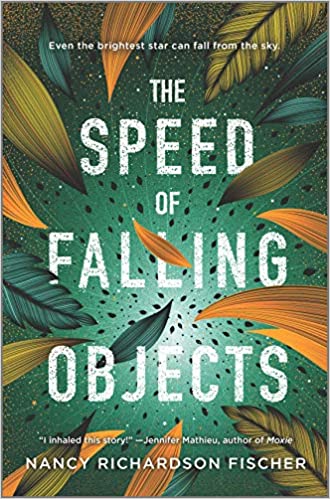
Life hasn’t been easy for Danielle “Danny” Warren. When she was 7, her adventurous father leaves her and her mother to become a famous “Reality Star”. Danny believes her father abandoned her because she suffered a horrible accident and lost her eye, an accident that not only stole her sight but also her courage. When her father invites her on a trip with him to the Amazon to film an episode of his Reality show, Danny believes it would be the perfect time to get to know her father and prove to him that she is not the frightened little girl he left behind. Unfortunately, the plane crashes into the jungle, and Danny not only has to face but she must also come to accept the man her father truly is.
The Speed of Falling Objects is truly an adventure story where the protagonist experiences more than her fair share of peril all the while falling in love for the first time.
I’m finding it difficult to put into words how much I loved this novel. I don’t often gravitate to novels written in verse but honestly, the cover of this one was breathtaking so I had to take a look inside. For the entirety of my reading, I had to sit still for fear of breaking the magic in which I found myself, magic that kept me transfixed upon the spiritually intimate relationship between Moth and Sani.
It’s been two years since Moth lost her family in a car crash. Although she lives with her aunt, she feels guilty to have survived and has felt displaced and lonely ever since. Moth drifts through school friendless and alone until she meets Sani, a beautiful young man who draws, sings, and plays music. But there is something amiss with Sani, he is loving and creative one minute, and then withdrawn and isolating the next. Moth suspects it has something to do with the medication he sporadically takes.
Moth and Sani form a bond that grows beyond friendship. He too feels displaced living with his mother and abusive stepfather and soon decides to travel to Window Rock on the Navajo Nation to be with his father. Moth, having fallen in love with Sani, goes with him. On this journey, they both discover truths about themselves truths that are both disturbing yet freeing.
After reading Me(Moth) I can say it’s one of the best YA books I have ever read. I found myself consistently writing down beautiful lyrical lines such as “ why do I feel like the dust of your name is buried in my bones (71) and “ I don’t know how to be whole anymore/whatever you need you can borrow from me. ( 134.) Aren’t they beautiful?!
I read it quickly the first time quickly because I needed to see a resolution of a multitude of thematic strings that had started to weave together, and then I needed to read again so I could pause and savour McBride’s beautiful use of language and imagery.
If I were still teaching High school I would use this novel or portions of this novel in a literature study. Foreshadowing, imagery, voice, atmosphere, figurative language are just a few curricular links you can make using this text as support; a text that most young adults would find enchanting.
When I read I often read from the point of view of a teacher. I envision how can I use an engaging book or portions of this book in class to teach figurative language, literary devices, or Author Style. If I was still in the classroom, Me(Moth) would be a mainstay for instruction on author style. More importantly, it is SUCH an engaging read it will definitely inspire a love of reading novels, especially novels in verse.
The novel deals with themes of identity, grief, mental illness, physical abuse, loneliness, culture, the importance of ancestors.
An interesting addition is Moth and Sani’s playlist. The lyrics of a few songs are scattered throughout a section of the text where Moth and Sani go on a road trip. McBride kindly includes this playlist at the back of the novel so if we so choose, we can listen to the same songs as the characters while the story is unfolding before us.
Amber McBride offers her book as “a gift, an iron/to smooth the wrinkles of [our] spirit”
I’m interested to know how other people are running book clubs during Covid. Is Zoom the “go to” platform for most? Or is there some other more intimate way to connect with our book people?
In September we had the opportunity to host book club in person for the first time in close to two years. Joy was palpable and we were so excited to see each other in person. Sadly we haven’t been able to meet in person since the arrival of Omnicron (sounds like some interstellar visitation whose sole purpose is to poop on everyone’s parade). Anyway, September’s meeting was the “first” book club of the season, the one where we share book suggestions and vote on the titles for the year and this year we have some wonderfully diverse genres:
      This is a sad, frustrating, yet compassionate story. In this book, is the main villain (I was going to write "antagonist", but villain is more appropriate) is alcohol that seduces and creates monstrous behaviour sympathetic characters.
      Although Agnes seems to be the main character, this is Shuggie's story. He is our anti-hero. For most of the story, Shuggie is a child trying to survive the hardships of poverty in Glasgow without an adult's guidance to help. It is Shuggie who has to take care of his alcoholic mother once his father abandons the family for another woman.
     Agnes is both beautiful and ugly. She leaves her first husband, "The Catholic", the father of her first two children, to marry a taxi driver by the name of Hugh Bain and soon after gives birth to Shuggie.
     I felt NO sympathy for Agnes for most of the book; I thought it was her vanity more than her addiction that led to her make the stupid, selfish decisions that jeopardized her life and the life of her children…until I came across this quote "She loved [Hugh], and he had needed to break her completely to leave her for good. Agnes Bain was too rare a thing to let someone else love. It would do to leave pieces of her for another man to collect and repair later." To me, the cruelty and selfishness of Hugh outweighed Agnes's weakness.
     Like I mentioned earlier, though, this is Shuggie's story. His heartbreak over his mother, his father's treatment, and his confusion about his sexuality make him a genuinely sympathetic character.

I thought about Shuggie long after I finished reading.
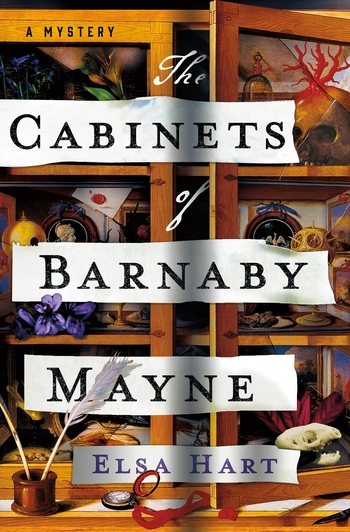
written by Elsa Hart I am a reading fiend. I can read book upon book upon book upon book. Summer holidays usually offers the opportunity where I make up for the lack of time I had during the work year. But this year was different. You would think that with a quarantine one would have more time to do what one loves. For me, this was not the case. I’ve been finding it really difficult to concentrate on reading for long periods of time. Short Stories? No problem. Poetry? Easy. But novels, no. And I’ve been crestfallen because of it. Luckily I was given an advanced copy of Elsa Hart’s The Cabinets of Barnaby Mayne, and my reading drought has thus been ended. I started reading this novel one early evening after dinner, and I was pretty my all the way through before the sun rose the next day. I could not put it down! What magic did Elsa Hart conjure to break me of this stifled reading curse? First off, an intriguing setting London 1703 where most of the action is centred around the home of a “collector”l Barnaby Mayne who is in possession of THE most extensive collection of wonders. This collection includes everything from skeletons of exotic animals from across the world, to strange fish preserved in chemicals, to gemstones, and rare flower and much much more. Secondly, memorable characters. Our protagonist, Lady Cecily Kay, has come from Smyrna to access Baraby Maynes “plant room” in an attempt to identify the various plants she collected in her travels. There is also an assortment of other characters who live within Sir Barnaby’s walls, all of whom have a different interest in his collection. Unfortunately, upon her first night, the house Cecily’s host is murdered, but why? The man who confesses to the crime cannot possibly be capable of the atrocity? Or can he? This novel is a wonderful murder mystery that keeps the reader captive with each secret revealed. And thirdly, I loved, loved, loved, the plot. The portrayal of the female characters, both Cecily and the character Meacan are smart and independent and interesting. I also really appreciated the fact that they were older and therefore approached situations with the wisdom and foresight that comes with age and experience instead of “learning as they go”. I was also charmed by this novel because a couple of summers ago, I was fortunate enough to visit Dublin. While there, I explored the museum that housed an extensive collection of all sorts of wonders. This book reminded me of that visit and how entranced I was with all the wonders that I saw. The Cabinets of Barnaby Mayne went on sale yesterday! Buy it! You’ll love it! Plus its a sure-fire remedy to the frustrating curse of a reading drought.
PS… here are some pictures from the Dublin museum. These are EXACTLY how I imagined Barnaby Mayne’s collection!!!!!
One of my favourite genres is Gothic Literature so one day, a couple of months ago I Googles “Contemporary Gothic Literature” and up popped a wonderfully detailed list of titles. One of the titles on this list was “The Toll” written by Cherie Priest. The caption under the title reads “Southern Gothic Horror with a Contemporary Twist”. Perfect.
Admittingly I bought this novel thinking it was an escapist pulp fiction – something easy to read and entertaining enough to distract me from the realities at hand. I soon found out; however, this novel is not only entertaining but wonderfully written as well—a combination of horror, mystery and humour.
What is it’s the premise? A bridge appears where no bridge should be. Right in the middle of the Okefenokee Swamp in Georgia. If you happen to be driving along the road when this bridge appears you just might be “taken” or rather there is a good probability you WILL be taken. By whom? By what? And what is it that lurks in the water….watching….waiting.
This novel possesses a variety of memorable characters however I absolutely adore the “godmothers” Miss Daisy and Miss Claire two rick as 80-year-old heroines who “[know]about everything that [goes]on within a hundred miles (pg. 11).
I found this novel highly entertaining, and because I love her writing so much I definitely will be reading more of Cherie Priest’s novels.
The film “Women Talking” has been nominated for an acadamy award this year. The film looks amazing. I’m going to watch it this weekend, but before I do I have been flipping through the novel upon which the movie is based. I blogged about his book years ago but I think its worth a repost. Try to get your hands on a copy and read it. I hope the movie is just as amazing as the prose.
This is an important book. This is a disturbing book. This is a book where the voices of women can no longer be silenced by tradition and fear. Horrifyingly based on a true story, Miriam Toews tells a story of a group of Mennonite women, members of a traditional colony in Bolivia who are forced to meet in the hayloft of a barn and determine whether or not they will break from the colony, the only home they’ve ever known. Their reason? Women and children in their community have been woken up battered, bruised and sexually violated. I’m not spoiling anything when I tell you that the abuse is at the hands of men in their own community, men they know and trust. It is a story that appears to be set in some uncivilised medieval time so what makes it even more horrifying is the fact the truth behind this story happened a mere decade ago. The idea of feeling unsafe with the threat of torture in your own home among your own people is a nightmare that exists for many.
Although this novel is heavy and at times emotionally taxing, it is not gratuitous; there is no need to be. The reality posed speaks for itself with no need for vivid imagery. Toews characterizes her women characters as being strong, heroic and humourous. These women are facing their truth, now what are they going to do about it?
Read this book. Read this book with your girlfriends, your mother, and your daughters. Talk about what you read and how you feel when you read it. What would you do? Flee or Fight? Would your screams of anguish turn into battle cries? The answer lies in the book’s title.