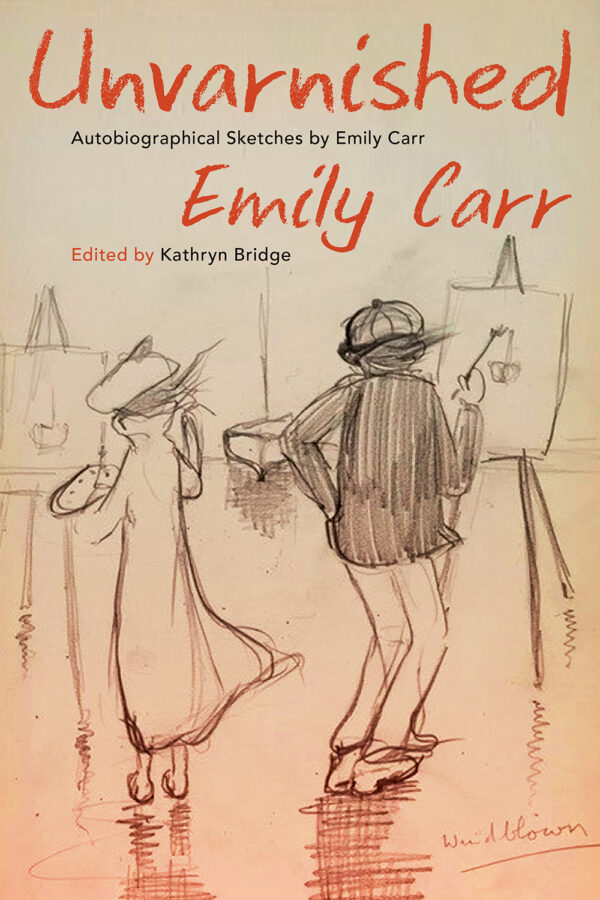
I love Emily Carr’s paintings. Whenever I get the chance to visit Victoria, BC, I try to see the Art Gallery of Victoria to view their collection of her works. I have, however, never read any of her prose.
Unvarnished me is a phrase Carr used to “describe herself, her personal writings, private papers, and objects she deemed her honest self” (Kathryn Bridge).
Unvarnished is a non-threatening yet intense immersion into Carr’s writings, writings that range from postcards she’s written to friends and family, personal journals, and her short stories. In addition, the text includes visuals of Emily Carr’s journals, artwork, and photographs of the artist herself.
Kathryn Bridge does an impressive job weaving together this collection, creating an intimate portrait of one of Canada’s most celebrated artists.
“ And yet, the stars are not lost. They form patterns. Constellations. If you know how to look, there are stories woven into the very essence of stars” (When Stars are Scattered).
Graphic novel grades 8-12
Themes displacement, political unrest, resilience, family, loyalty
The story takes place over three significant times in the life of our protagonist: as a child, as a teenager, and as a young man.
The brothers Omar and Hassan live in a refugee camp in Kenya. When the story begins, they have already lived in the camp for seven years after fleeing Somalia under the threat of violence. Tragically, during this time, their father was killed and their mother went missing. The refugee camp in which they live is incredibly large with markets, clinics, schools, and neighbourhoods of various wealth.
Omar would love to go to school but doesn’t because he fears for the safety of his little brother Hassan. Hassan is nonverbal and because of the traumatic experiences in Somalia, becomes extremely distressed when Omar leaves him.. Eventually, Omar gets the chance to attend school, with the help of their neighbour and guardian Fatuma who agrees to care for Hassan. At school, Omar realized that the only way he will be able to leave the refugee camp is to become educated enough to impress the UN workers who visit. Then, with luck, he will eventually succeed in his “interview’ to be placed in a new country.
The day-to-day life of a political refugee is detailed in this novel. At times it the novel describes the violence the boys experienced while fleeing Somalia and the violence Hassan faces in the camp itself. This violence, however, is not gratuitous or graphic. This graphic novel is an effective and engaging way to present the realities of a refugee camp through the convincing and empathetic voice of someone who has actually lived it.
This novel would be very suitable for book clubs in jr. and sr. high. Several cross-curricular connections can be made with Social Studies and Religious Studies. The various themes offer opportunities for depth of discussion and reflection.
If not used as part of classroom study, it definitely should be made a part of every school or classroom library.
“…every question possessed a power that did not lie in the answer.” Elie Wiesel Night
A question can be significantly more important than the answer. If we don’t question, we naturally assume the “truth” we are presented with is just that, the truth. Then acceptance leads to manipulation and ultimately, for lack of a better term, mush for brains. When we question, we inquire. We show inquisitiveness and don’t just sit through life passively like dough waiting to rise. Questioning means we’re alive. It means we have an opinion. It means cures for cancer. World peace. Nobel prizes. Questions mean change. To respectfully challenge the status quo is our responsibility as human beings. It encourages accountability. Creativity. Logic. Three things I see lacking in the world. And sometimes in my own immediate vicinity. We need to encourage inquiry in others and, most importantly, in ourselves. To not be afraid of throwing out a “why” and to be equally unafraid of catching one. We need to cultivate genuine inquisitiveness in ourselves. Excitement for learning. Sometimes a difficult thing to do through the exhaustion of the day filled with work and obligation. But the excitement someone builds in herself about the process or even the mere probability of acquiring knowledge is infectious. How often do we see a friend learning to and successfully remodeling her own home, or acquiring a new language, or training for a new job? And we think, “I could do that.” But we leave it there. What we should be saying is, “I want to do that, and I will.” Then go out and make it happen.
If you’re looking for an engaging, suspenseful whodunnit with interesting characters, look no further. The Midnight Killing starts with a gruesome murder presented in the first few pages. However, we soon meet Detective Inspector Danny Stowe and forensic psychologist Dr. Rose Lainey whose shoulders we peer over throughout the investigation. Having been good friends during their university years, Danny and Rose complement each other in their investigation. Each hero has an interesting backstory that the author weaves skillfully into the story of the murder without causing the momentum of suspense to falter. The novel presents a suspenseful story with various fascinating suspects. Mystery and Thrillers is one of my favourite genres, and Dempsey is incredible at creating suspense and incredibly engaging characters. I’m hoping she writes a series with Stowe and Lainey because she’s become, my new favourite authors.
Will be published in Feb 2022 Thank you Netgalley for the advance copy.
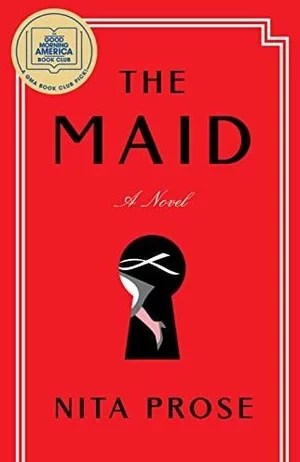
I have a wonderful NEWLY Published book recommendation!! Brand spankin’ new in fact. Released January 4th.
Molly is an interesting girl. Some would say quirky…some are crueler and say she is weird. You see, Molly can’t read social cues, isn’t very good at small talk, isn’t the best judge of character, and is obsessed with cleanliness. This second attribute comes in handy because Molly is a maid. One of the best maids, in fact, who works at the posh Regency Grand Hotel.
Molly loves her job. She loves to see how she can magically transform a dirty room into a shiny welcoming sanctuary. However, after her grandmother dies, life becomes more complicated. One day Molly discovers a dead man in one of the rooms, and she soon becomes entangled in a web of deception and manipulation, a web where people take advantage of her innocence.
I love the first-person narration in which this story is written. Molly’s use of proper etiquette and elocution and a penchant towards the literal makes her a sweet and funny protagonist inserted in a compelling murder mystery.
A heartwarming, suspenseful read with a memorable main character. A fantastic novel to start the new year.
When we are young, when everything seems new and we’re open and curious to learn, we listen to those who know or can teach us skills to “find out” for ourselves. How to ride a bike. How to hold our pencil. To skate. Write. Read. And we listen with trust and childlike appreciation to those who will show us how and then to those who will show us how to do better. But then, somewhere along the way, this trust and appreciation turn to frustration and impatience. As teenagers, we say, “who are you to tell me what to do?” “Leave me alone.” “This sucks.” Eventually, we realize that we indeed do not know everything, at least not the things we need to know to succeed at a new job, make money, buy a house. All the “things” that come along in life that are new. So we listen and learn from the experts who will teach guide and us. But then we stall. Again we think we know it all. We don’t want to learn because it will require effort, or change or, heaven forbid, more responsibly. We’re scared to fail. Or too proud to acknowledge a need for growth. So we muddle around in a rut expecting accolades for redundancy. Or again, to be left alone in a cocoon of unaccountability. And we may resent those who try to teach us, and this time we think instead of say: “Leave me alone” or “who are you to tell me what to do.” or “Let me do what I’ve always done… even if it’s mediocre. Because complacency is familiar. And doesn’t require effort. And I think the only way to regain that childlike trust to learn from someone else is through humility. And the acknowledgment that someone else might, in fact, know something I don’t know. And if that person has my respect, then mentors can exist even for adults. And I can learn above suspicion with the same innocence as a child.
I love Kelley Armstrong. My favourite Series of her’s is the Cainsville Series.” I started the first one, Omens, and then proceeded to stay awake all night reading it. There are 5 titles in this Series if you’re interested. Armstrong’s newest novel is A Rip Through Time which sets us up for a whole new series; this one is about serial killers and time travel. HOW FUN DOES THIS SOUND! Mallory, our heroine, is a homicide detective from Vancouver. She is in Edinburgh, Scotland, to be with her dying grandmother. While on an evening run she hears a scream and goes to investigate just to be knocked unconscious. She then wakes up in the year 1869, inhabiting the body of a young housemaid named Catriona. Mallory soon discovers that Catriona was strangled in the same alley more than a century before Mallory was attacked. Mallory now takes it upon herself to solve Catriona’s murder, all the while trying to figure out how to get back to her own time and place in history. My favouite thing about Armstrong’s writing, besides the incredibly imaginative and entertaining plot, is the voice of her protagonists. The first-person narration presents Mallory as a funny best friend relaying a crazy story over a bottle of whiskey. But, of course, the more you drink the crazier the story becomes, and you laugh and laugh and laugh until your belly aches.
A Rip Through Time will not be published until June 2022 making it the perfect addition to your summer reading list.
“If only we could pull out our brain and use only our eyes” Pablo Picasso.
I sometimes have the tendency to overanalyze.
Ok, I often have the tendency to overanalyze and question and stew, which ultimately leads me to doubt my interpretation and second guess my response.
At times it’s exhausting.
And I wonder,
wouldn’t it be wonderfully freeing to once in a while absorb information simply at face value?
It is what it is.
To view it as a manifestation of truth with no assembly necessary. To see something, just to see it. To see someone just to see them.
To observe without elucidation or analysis.
To experience without intention.
Sometimes this is easy. Immersing myself in nature. Sitting on a beach looking out over the great expanse of the ocean. Inhaling the salty air deeply and listening to the lapping of the water.
Or
driving through the mountains, the white peaks, the small trickles of melted water relenting to gravitational force and winding their way down the mountainside.
Watching fields of golden wheat dance in the wind.
No interpretation is needed.
Each
just
is.
It’s unfortunate such experiences don’t happen as often as they should. The life we create for ourselves, especially in adulthood, is crammed full of exterior stimulus of an electronic nature. The constant bombardment of information that needs to be processed and either stored or dismissed. Evaluation required.
Maybe we all have the eyes of an artist; we just need to “pull out our brain” in order to use them.
I live in a place of extremes. This last week, my city had the distinction of being the second coldest place on the planet. It has since warmed up by 25 degrees. It is a welcome relief to finally have the walls stop snapping and the fog caused by exhaust sitting in the air dissipate. Still, I’m finding it difficult to figure out how Mother Nature wants me to behave. Do I wear wool or cotton? At night do I keep handy a heating pad or fan? Warm soup for supper or a refreshingly crisp salad? And although I’ve gotten used to these extremes (albeit I find them somewhat annoying), I still look forward to peaceful spans of continuity and predictability. In fact, sometimes, I long for them. I’m not really talking about the weather. But, we all know, talk of the weather is usually a disguise for something else. Something deeper. Extremes in life are difficult. Those surges of maniacal frenzy that occur at work no matter how diligently you measure yourself. You plan and pace with perfect practicality, but they always seem to swirl upon you, and you fight to keep your nose above the swell. You usually do, but not without the sleepless nights, moments of panic, and “medicinal” pouring of wine. Or relationships where you are besieged by attention and obligation, sometimes welcome, other times… not so much. Days where you see and talk to no one about anything of significance and long for a passionate and intellectual conversation peppered with emotion, or, you are emotionally and mentally drained and want to crawl into a hermit hole and watch all the extended versions of the Lord of the Rings Trilogy in one sitting. I guess it’s true. Life is filled with ebb and flow. And we can’t appreciate certain moments unless we’ve experienced their opposite. You can’t breathe a sigh of relief during the holiday unless you’ve lived through the chaos at work. You can’t KNOW happiness unless your heart has been broken.
I’m a nerd. I love books. I especially love books about books, libraries, and words. I also gravitate towards feminist literature. Lucky for me, The Dictionary of Lost Words is a wonderful combination of both. Our protagonist Esme loves words as well, probably because she spends her childhood under the table in the scriptorium where her father works compiling words and definitions for the Oxford English Dictionary. While there, little treasures in the form of words accidentally fall from the table, and she reverently gathers them up and keeps them safe. However, as she gets older, Esme notices that other words are carelessly left and that these words tend to be more relevant to the world of women. So Esme takes it upon herself to collect as many words as she can so that she can build a dictionary that will acknowledge and preserve these words. I love Esme. She is curious and brave and so, so smart. I love the relationship he has with her father; for a man who works with words, he can find no word appropriate enough to express the love he has for Esme. I fell into this story immediately. William’s vividly transported me back in history, where I viewed a world from the shoulder of a fictional character whose story was inspired by true events. What a wonderful place to experience history!
I have really struggled this year, reflecting upon the past year and setting goals for this new one. No lie, this last year has been a tough one for me. I was all brave-like and heroic, espousing upon the positivity I found even in the time of a pandemic. And then, in April, not only did I crash and burn, I did so in epic proportion. It was a full-time job (on top of a full-time job) to maintain my physical and mental health. Now, those of you who suffer anxiety and depression like I do know that no amount of telling yourself “consider yourself lucky, other people are experiencing huge financial issues and death of loved ones or sickness themselves” made me feel better, in fact, telling myself this only made me feel guilty for feeling sorry for myself (yay for “Good Catholic Guilt” and honestly as I write this it sounds like I’m complaining which makes me feel guilty about complaining. Yesh).
Anywho, I’m better! Yay! But I’m fully aware that “better” ebbs and flows.
That being said, I’ve rephrased “New Years Resolutions” to “Things I’m going to Work On,” and I thought I’d share them with you.
There is only 2 this year:
1. Train and complete another ½ marathon in October.
2 . Reframe my thoughts and the things I say towards the positive.
Does the second one seem silly, “Pie in the Sky” and a regurgitation of every wellness book on gratitude published over the last decade? Maybe so, but I’ve been practicing. And it’s been working. I feel better. I smile more. I hope I can keep it up.
What “Things I’m Going to Work On” is on your list?
I’m interested to know how other people are running book clubs during Covid. Is Zoom the “go to” platform for most? Or is there some other more intimate way to connect with our book people?
In September we had the opportunity to host book club in person for the first time in close to two years. Joy was palpable and we were so excited to see each other in person. Sadly we haven’t been able to meet in person since the arrival of Omnicron (sounds like some interstellar visitation whose sole purpose is to poop on everyone’s parade). Anyway, September’s meeting was the “first” book club of the season, the one where we share book suggestions and vote on the titles for the year and this year we have some wonderfully diverse genres:
So this month I’ve been trying to read more “Middle School” books so that I can confidently recommend new novels to teachers in our schools. So besides increasing my book total for my reading goal for the year 2021 I found some REALLY good middle school reads that have been published over the last few years. Here are just a few:
Hello, Universeby Kelly Entrada,
A group of kids with totally different personalities become close friends after the universe throws them together to search for a missing boy.
Virgil Salina: a sixth-grade boy. So shy his family calls him “Turtle”. He is small for his age and therefore gets bullied by his classmates. He becomes slightly traumatized by his Lola’s (grandma’s) Filipino folktales about stones gobbling up young boys. Virgil has a guinea pig named Gullivar that is his best friend.
Valencia Somerset: is an 11-year-old girl who is questioning the existence of God however she stills talks to St. Rene. Valencia is deaf and suffers from nightmares of abandonment. She is tough and doesn’t think she needs a “gazillion friends” in fact her best friend is a stray dog she finds in the woods near he house.
Kaori Tanaka is a twelve-year-old girl who fancies herself a psychic and offers her services to anyone who isn’t an adult. She is confident and creative and always makes herself available to help people by giving them “readings”
Chett Bullins is a bully. He particularly likes picking on Virgil. He feels uncomfortable around Valencia because he believes she can read lips and therefore knows all his secrets. Chett is particularly preoccupied with finding and capturing a snake just to prove how tough he is to both his classmates and his father.
Themes of friendship, courage, and resiliency.
Black Brother Black Brotherby Rhodes Jewell Parker
Donte and Trey are brothers. Donte hates school probably because he is one of the few black boys who attend and is therefore treated unjustly by the predominantly white student and faculty. To make matters worse, Donte’s brother Trey presents as white and doesn’t suffer racism. In trying to discover where he belongs in his world, Donte starts training under a former Olympic fencer Arden Jones and soon becomes a competitive fencer. Themes of bullying, racism, resilience, family, and friendship.
He Who Dreams by Florence Melanie
Our young protagonist John finds his identity in being one of the strongest soccer players at his school. One evening, as he is waiting for his little sister to finish her gymnastic class, he discovers an Indigenous dance class. Sensing a connection to the music, he forges a friendship with the dance teacher who encourages him to try Indigeninous dance himself. John tries to balance both the Irish and Cree sides of his culture but keeps his dancing a secret from his family as he navigates the mocking of his soccer teammates and the hostility of the boys in his dance class.
Themes of identity, family, culture, courage.
The Science of Unbreakable Things by Tae Keller
With the help of her friends, Natalie sets out to win a science competition so she can use the prize money to help her mother overcome depression by flying her to see a rare orchid known for surviving impossible odds. This story includes humorous illustrations and THE most engaging footnotes that help us love Natalie even more.
Themes of mental health, friendship, family.
Allergicby Megan Wagner Lloyd illustrated by Michelle Mee Nutter
Allergic is a graphic novel. It is a heartwarming story about Maggie who desperately wants a pet but is devastated because she is severely allergic to pet dander. Maggie takes it upon herself to outsmart her allergies and try to find a pet that she isn’t allergic to.
Themes of family, friendship, resiliency.
Front Deskby Kelly Yang
Mia Tang and her parents immigrate from China and take jobs managing a motel – a place where they not only work but live. Unfortunately, the owner of the motel is corrupt and takes advantage of the Tangs by not paying them a fair wage, and by taking the cost of any damages caused by hotel guests out of their paycheck. Although living in and managing the hotel has its hardships, Mia meets an assortment of hotel “residents” who are kind and helpful and end up being allies of the Tangs. Mia, being the precocious, brilliant 11-year-old she is ends up saving the ay for not only the hotel guests but for her own family.
Themes of inclusion, bullying, the immigrant experience, friendship, and resiliency.





 Ink And Spine