The Education of an Idealist

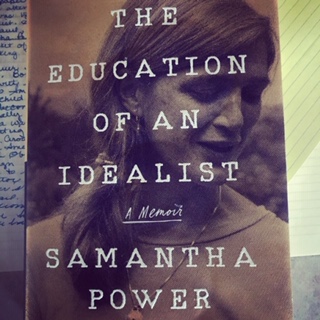
When I was thirteen, I wanted to be a Secret Service Agent. I clipped all the articles from the newspaper that covered the attempted assassination attempt of Ronald Reagan. I would imagine myself dressed in a black suit carrying a gun. Years later, I wanted to be a journalist. Instead of protecting politicians, I would write about them. I would travel to get the story and then I would write the truth. When I picked up Samantha Power’s memoir The Education of an Idealist and read the jacket cover, I thought immediately that “this was the life I wanted to live all those years ago.”.
Power tells the story of her life born in Ireland and moving with her mother and brother to America when she was a young child. She learns an American accent and plays baseball and assimilates quite naturally into the Culture.
Powers grows up, goes to college and eventually becomes a war correspondent assigned to cover the war in Bosnia cultivating a strong sense of justice regarding war victims.
Back in America, Samantha works with Obama’s presidential campaign and eventually works her way to becoming The United States Ambassador to the United Nations.
Power is the master of detail. The author must have been journaling or writing consistently throughout her experiences — a habit of a journalist. Reading the memoir of a writer is always a pleasant experience because gifted writers have a strong writer’s voice it feels as though they, or in this case, Samatha Power herself was sitting across the table telling her stories to me over a cup of tea…or a glass of whiskey.
What an inspiring book for young women to read. To read the life of bravery, creativity, political astuteness and empathy and all the adventures that come with it.

“…the relief of a father who has been reunited with his son, newly free of a deadly disease. The look on a government ministers’ face as he traverses a rainbow crosswalk. the insistence of diplomats to go on serving their country,  even when being ignored and insulted because they know that our nation is bigger than any one leader. And the persistent attempts- after unforgivable acts- to find the humanity in one’s foe” (pg 552).

A Nearly Normal Family

A Nearly Normal Family by M. T. Edvardsson

The Sandells are a perfectly normal family leading a perfectly normal life. They play Monopoly, go on hikes, listen to podcasts. Their reality is normal, yet sometimes mundane everyday reality. Until one day they get a phone call from a lawyer saying their daughter Stella has been arrested on suspicion of murder. It seems Stella’s much older lover has been brutally stabbed to death.
The novel is broken into 3 separate points of view. Father, Daughter, Mother each first-person narrative giving their own interpretation and involvement with the crime. Edvardsson is very successful in creating distinct and convincing voices for each. And I admired the artful way the author made sure to weave the essential plot points from the various point of view without breaking continuity.

A Nearly Perfect Family topped off my holiday reading perfectly. Easy and quick to read if you want to escape a cold winter day wrapped up in a cosy quilt.

The Blacksmith Queen by G. A. Aiken

The Blacksmith Queen by G.A Aiken

What an enjoyable romp through the fantastical world of the Blacksmith queen. The book grabbed me and held me hostage from the opening pages where a king has died, and his offspring are murdering each other for his crown.

The story quickly moves to the forest where the Smythe family is feeling the repercussions of the king’s death. The Smythe family is gloriously filled with strong, courageous, brutal women to revel in combat (most often with each other). Soon we learn that Beatrix, one of the sisters, has been prophesized by witches to be the next queen. This prophecy puts her and the entire family at risk from the remaining competing royals.

I have a penchant for strong female characters. Rarely have I come across a character like our main character, Keeley. With a body honed by “womaning” a forge Keeley not only has the physical strength to fight any man or beast, she also has unwavering courage that holds fast no matter the circumstance.

With a fast-paced plot, a nice bit of gore, hilariously funny characters and just a smidge of sex, this novel was the perfect read at the end of my summer. I laughed aloud innumerable times (a couple of times in the waiting room at the doctor’s office, which garnered me many a stare). And yay! There are several more Aikian novels out there for me to read!

The Blacksmith Queen comes out August 27, 2019

Island by Johanna Skibsrud

I wish I would have had a copy of Johanna Skibsrud’s Island 30 years ago when I was studying Heart of Darkness in British Literature class at university. If I did, I would have had the patience to read all the way through Joseph Conrad’s story of moral corruption. (20 years later I gave it another go, and you’d be pleased to note I read it in its entirety and appreciated its brilliance.).
Skibsrud’s reimagining of Heart of Darkness is a timely novel in the age of “us” and “them”, a mentality that seems exacerbated by the current political situation. This novel forces us to contemplate our role in the various structure that form our identity, be it political, historical or political. It reminds us that governments can be built on precarious scaffolds that strive more towards power than people.
The story is told from the point of view of two characters that exist on opposite ends of the pollical spectrum, Lota, a young revolutionary, and Racheal a “first secretary” of the foreign service working at the “Empires” embassy. Both women struggle in their respective realities using memories of their past in an effort to make sense of their present.
Island is a novel I would seriously consider using in my classroom. Not only does it fit perfectly with the curricular themes of “identity”, “nationalism”, and “globalization” it also is worthy of literary study.
I recieved a copy of this novel from Netgalley

Island comes out September 24 2019

Lady Rogue by Jenn Bennett

I’m always in search of novels with strong, independent female protagonists to put on the shelf of my little classroom library. “The Lady Rogue” written by Jenn Bennett presents us with Theodora or “Theo”, a seventeen year old young lady with a penchant for crossword puzzles, cipher codes, and the occult. When Theo’s “adventurer” father goes missing while attempting to possess the lost ring of Vlad the Impaler (yes Dracula himself) Theo embarks upon an adventure of her own in an effort to piece together her father’s last movements and ultimately save him from murderous treasure hunters.
I thoroughly enjoyed this novel. Bennett has written novel that is a combination of just the right amounts of adventure, gothic elements, history and romance to engage any young adult. I especially enjoyed the voice of Theo. Although the story is set in 1938, Theo speaks and thinks like a REAL seventeen year old girl. She has a wonderfully sarcastic inner dialogue that had me chuckling regularly. I hope Jenn Bennett writes share more of Theodora’s adventures with us in the future!

”Lady Rogue” comes out September 3.


“The Water Cure” by Sophie Mackintosh

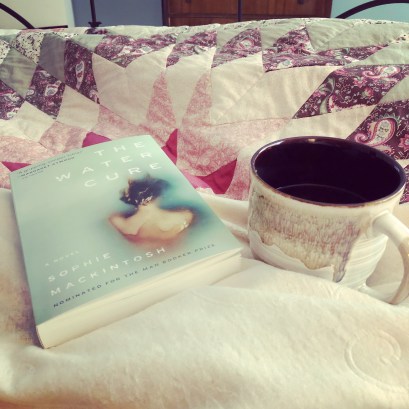
A sisterhood born out of blood held together for survival; survival against parents, strangers and family. I sympathize for the sisters, they were, after all, products of their environment, an environment of isolation and abuse. Mother and King believe that pain keeps you safe. Emotional pain protects you from a broken heart, mental pain protects you from determining the truth behind the hill in which you live, and physical abuse? Well, physical pain cleanses you from impurities and corruption.
When the outside world suddenly infringes upon your “haven” making you question the only life you’ve ever known, do you fight against it? Or do you let it consume you?
I loved this book. I would think about Lia and Grace even after I closed the pages for the day. I need to talk about this book so I’ve recruited friends to read it so that we can debrief.

img_5560


Novel: “Women Talking” by Miriam Toews

The film “Women Talking” has been nominated for an acadamy award this year. The film looks amazing. I’m going to watch it this weekend, but before I do I have been flipping through the novel upon which the movie is based. I blogged about his book years ago but I think its worth a repost. Try to get your hands on a copy and read it. I hope the movie is just as amazing as the prose.

fullsizeoutput_c8b

This is an important book. This is a disturbing book. This is a book where the voices of women can no longer be silenced by tradition and fear. Horrifyingly based on a true story, Miriam Toews tells a story of a group of Mennonite women, members of a traditional colony in Bolivia who are forced to meet in the hayloft of a barn and determine whether or not they will break from the colony, the only home they’ve ever known. Their reason? Women and children in their community have been woken up battered, bruised and sexually violated. I’m not spoiling anything when I tell you that the abuse is at the hands of men in their own community, men they know and trust. It is a story that appears to be set in some uncivilised medieval time so what makes it even more horrifying is the fact the truth behind this story happened a mere decade ago. The idea of feeling unsafe with the threat of torture in your own home among your own people is a nightmare that exists for many.

Although this novel is heavy and at times emotionally taxing, it is not gratuitous; there is no need to be. The reality posed speaks for itself with no need for vivid imagery. Toews characterizes her women characters as being strong, heroic and humourous. These women are facing their truth, now what are they going to do about it?

Read this book. Read this book with your girlfriends, your mother, and your daughters. Talk about what you read and how you feel when you read it. What would you do? Flee or Fight? Would your screams of anguish turn into battle cries? The answer lies in the book’s title.

CBC interview with Miriam Toews

Book Club Lists!!!

09792ca7af5d0c9104269a016596f6f0

My book club list of titles for 2017-2018

I thought I’d post the list of books my book club read this year. Our book club has been in existence for over 15 years. Even though over time some members have sadly moved away We’ve always been able to collect a few wonderful additions to our group. Because most of us work in some way or form with Education, we meet at the end of the summer to choose our books for the year. We all meet at someone’s house (where there is ALWAYS wine…sometimes whiskey, and snacks) with title suggestions. Sometimes a member shares a novel she’s already read and KNOWS it will lend itself to discussion, but most often the titles proffered are of literature that none of us has read. We usually end up with near 20 title suggestions.
How do we choose? We usually have 8-9 book club meetings a year. This means that each of us gets 8 votes! Protocol is that each member can vote a number of ways: one vote for each choice OR if you really, really, REALLY want to read a book you know the other members might not be too keen on reading you can put all 8 votes on that one book (as per my Jonathan Strange and Mr Norrell takedown of 2010). The top eight novels are picked! Then we decide the order with which to read them.

I can’t wait to meet at the end of the summer to determine what books we will be reading for the following year.

I love book club. It simply makes me happy.

I thought I’d share last year’s list with all of you. I will be sure to post this year’s list as soon as I can!
Women in the Castle by Jessica Shattuck – September
In the Dark Dark Wood by Ruth Ware – October
The Book of Joan by Lydia Yuknavitch – November
Inferior by Angela Saini – January
Borne by Jeff Vandermeer – April
The Break by Katherena Vermette… – December
The Heart’s Invisible Furies by John Boyne
Secret Path by Gord Downie and Birdie by Tracey Lindberg – March
Scythe by Neal Shusterman – May
Magpie Murders by Anthony Horowitz – June
Bonus: The Power by Naomi Alderman

Go Ask the Kids

I never used to read Science Fiction. To recommend books to my students who are Sci-Fi readers, I decided to expand my repertoire of genres. Not knowing where to start, I went to the source, and I asked my students for suggestions. The first title proffered? Unwind by Neal Schusterman. Much to my surprise, I loved this sci/fi dystopic story. It was a novel that opened numerous themes, the types of topics that engage young adults: parent abandonment, friendship, medical ethics. And “Unwind is wonderfully a part of a series: “Unwind” “Unsouled” “Unwholly”, “Undivided”. Us book nerds LOVE an excellent long series right?

As much as I loved the Unwind series, it is Schusterman’s newest series that has captured and tightly bound my interest to the point where I CANNOT WAIT UNTIL 2019, for the third book to be released. I recommended Scythe to my book club, filled with mothers, teachers, and retired librarians. Undoubtedly a collection of ladies with distinct literary taste. They all loved it and promptly got their hands on book two ThunderHead.

What is the Scythe arc about? Imagine no politicians, every decision is left to the Thunderhead, an entity similar to “the Cloud”. Imagine a world where technology has advanced to the point where no one dies, and if they do, they can easily be “reassembled”. Imagine this world becoming overrun by humans to the point where we, as a species, must be culled. Now imagine if your calling was to cull humans. A respected, feared and almost sacred calling….to be a Scythe. Like Unwind, this series has the potential to incite in-depth, introspective classroom discussion.

It should be noted that he Unwind series is consistently signed out of our school library. The novel has also been used in our Religious Studies class for the opportunities created for discussion on ethics and morality. Scythe is becoming popular at our school as well mainly because we have a solid group of die-hard Schusterman fans.

I had the opportunity to hear Neal Schusterman speak at the National Council of Teachers of English conference a couple of years ago. He remembers what it was like to be a student, a student with imagination in need of an opportunity to create. He KNOWS what it takes to turn reluctant readers into avid readers.

Go to the readers in your class for title suggestions! You know who they are!

Link to Neal Schusterman’s site where you can learn all about his amazing series can be found here.

Novel: See What I Have Done


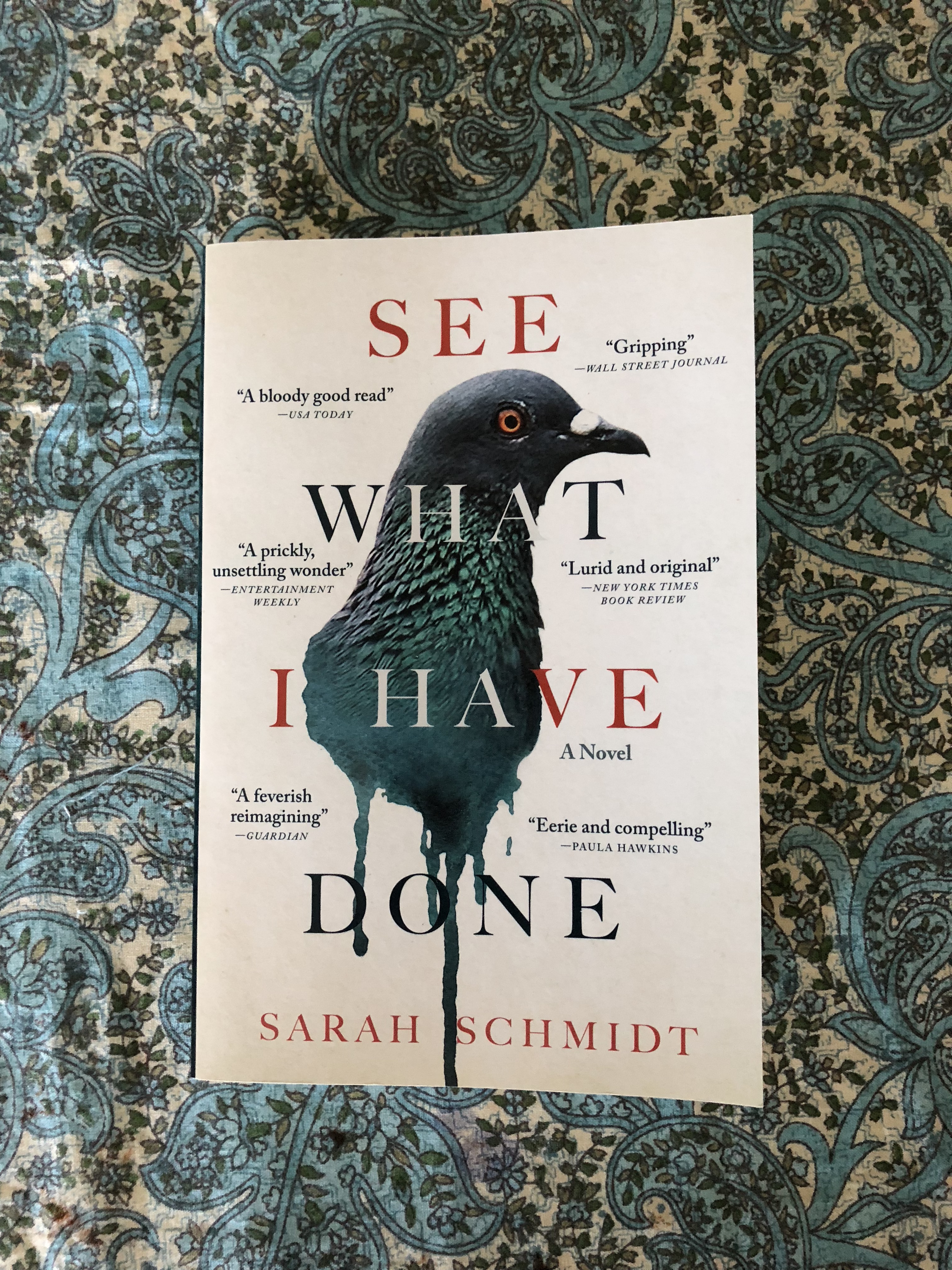
See What I have Done

Sarah Schmidt

Why are we so intrigued by parricide? Maybe it is because we cannot imagine a more profound love that exists between a parent and a child. There seems to be a resurgence of interest in one such relationship, that between Lizzie Borden and her father. With the release of the film Lizzie directed by Craig William MacNeill and last year’s PBS documentary Lizzie Borden Full Biography as well as a plethora of novels built around the murder (see Bookriot).
This summer I picked up See What I have Done by Sarah Schmidt honestly first of all because I really liked the cover. You’ll understand the significance of the severed pigeon head after you read the novel. The second reason why I picked it up is that Schmidt uses multiple narrators to tell the story. I LOVE this format; getting the viewpoints from all the participants of a story makes who questions who is most reliable?

The chapters written in Lizzie’s voice are convoluted and claustrophobic. Instead of feeling empathy for Lizzie in her confusion we feel frustrated, echoing her sister Emma’s frustration. In fact, Emma is the one I felt closest to. I wanted her to leave that house and STAY AWAY forever.

Schmidt uses VERY effective imagery creating a visceral reaction in this reader. The image of nausea and throwing up (purposeful poisoning? Salmonella? Mutton broth sits on the stove for how long?) are rampant, inferring both psychological and moral rot. And don’t get me started on the descriptions of blood. Also, the repetitive taste and sight imagery regarding pears is interesting. I would love to get into a discussion about its purpose in the novel (Atmospheric? Symbolic?).

The secondary story of Benjamin weaves nicely with the story of the Borden’s murder. An individual struggling with hostile feelings of betrayal and anger towards his own father successfully in supports the relationship between Lizzie and her own father. Is there such a fine line between love and hate?

This book drew me into its web from page one. The story of Lizzie Borden is interesting in and of itself, and worth reading, however, Schmidt’s account is written in such an entertaining and mesmerising style reading it in one sitting makes for a full day’s entertainment. As a bonus, the story runs very close to the facts around the crime as per the PBS documentary 2017. Small details such as the Andrew Borden insisting on having all his doors locked each night, and the small maniacal laugh heard coming from Lizzie as she stood on the stair landing as stated in the documentary are included in the novel making it informative as well as entertaining (what better way to learn history than through story!).

I can genuinely say that “See What I have Done” has been my favourite read of the summer thus far. I will be recommending this one to my book club not only because it is uncomplicated and entertaining, but also because it offers a multitude of topics for discussion! Father/daughter relationships, familial betrayal as well as familial loyalty, feminism etc.

BDlmVkO9RDCKlRvT5kB0sg.jpg

The Power of a Private Library

The magic of a private library is something every child should experience. I had such a library when I was growing up. It was two book-lined shelves above the freezer deep in our basement. I was a farm kid born and raised near a small Northern Alberta town that for the longest time had no bookstore. We did, however, have a public library but the library would not “allow” farm kids to sign out books…because they might not return them on time due to the long drive and all a fact I still hold bitter in my heart.

So I pillaged my mother’s library, a spritely array of volumes from Reader’s Digest Book of the Month, garage sale treasures and old school texts.I remember them all clearly. And my mother never, ever censored what books I could and could not read (although sometimes she made a few “unavailable” for her adolescent daughter). Here are a few books that will always remind me of growing up on the farm:

Little Women by Louisa May Alcott. It was all about Jo. I was a tomboy; Jo was a tomboy. She was more a sister to me at times than my own two. At the time of “The Great Bang Massacre of ‘72, when my mom would take us to the neighbor lady to get our haircut (it wasn’t years later that I found out she wasn’t a certified hairdresser) my distress was minimized when I read of Jo cutting her beautiful long hair.

Gone with the Wind by Margaret Mitchell. I used to go up to the stone pile atop the hill behind our house and read aloud Scarlett O’Hara’s dialogue…especially between her and Rhett. The “Old South” was the furthest thing away from my reality of Northern Alberta but that didn’t matter because there was Rhett. Rhett Butler was my first literary crush.

Jane Eyre by Charlotte Bronte. Who was the woman in the attic?  What was HER story? Is she a ghost?I couldn’t care less about Jane, I wanted to know about the crazy lady. It wasn’t years later until I read The Wide Sargasso Sea and found some possible answers.

I wanted to be just like Desiree in Annemarie Selinko’s novel Desiree. I wanted to grow up to be like with Desiree than I Jane. Desiree was precocious, she was a rule breaker, and she had caught the eye of young Napoleon. I was in these pages I got an understanding of what the grown-ups called “little man syndrome.” And Desiree could make quite the impression at a party smashing her glass splattering wine in a great arc across  Josephine’s white dress – a scene forever in my imagination even though I haven’t read the book in decades. (There is a new-ish 2010 edition out with a beautiful cover!)

The Happy Hooker by Xaviera Hollander…ok, I didn’t read a lot of this one. I think this book was making its way around the neighbourhood because the neighbor lady’s name was written on the front cover (come to think of  it may have been the name of lady that “cut” my hair!!). I would sneak down into the basement and sit on the freezer and read until I heard footsteps on the stairs which meant I could only read snatches at a time.  I knew it was salacious reading because I never took it out of the storage room. One day the book disappeared off the shelf. I have a feeling mom knew I was sneaking snippets of this text rather than sneaking cookies. (Side note: while discussing this post with friends I have since learned that they too covertly read Hollander’s memoir. Was it the taboo book of the 70’s that all adolescent girls wondered about? What was the book of the 80’s?)

Being able to escape into this little “two-shelf” library was especially important to me during junior high. It was a place where I could magically escape the melodrama and bullying that sometimes accompanies adolescence. I visited this library almost every week, replacing one book with the next. I so loved my mother for letting me have free access to everything and anything I wanted to read.

I wish every child to have such a place.

I could cry,

and laugh

and be scandalized

all atop that freezer,

book in one hand,

frozen cookie in the other.


Love: A Gracious Dream

“There arose a perfume of tenderness, that ghost of passion which, in the most unexpected relationship, can make a whole lifetime devoted to irksome duty pass like a gracious dream” (pg. 74)

The Bridge of San Luis Rey by Thornton Wilder.

I have fallen in love with Thorton Wilder because of this quote.

How wonderful would a relationship like this be? Having to get close enough not only in physical proximity but emotional proximity as well, to one person and stay there long enough to inhale that “perfume of tenderness”

where your first instinct would be to wrap your arms around this person and hold them close.

Tenderness without forethought, without premeditation, without any agenda.

No pretension.

To be pleasantly surprised at a love that grows where you didn’t expect it to grow. And you look upon it in wonder, finding it near impossible to believe that it truly exists in you,

the most unlikely of places,

or so you believed.

Where obligation and duty never really existed in its denotative form. All business like and astringent.

No boundaries set by written laws or verbal promises but rather

a fidelity that is unexpected and natural.

Some of us have found in our relationships some such a manifestation of Wilder’s love

and some of us are still waiting.

Whatever the case I hope we recognize it as such

and hold on to it as a dream come true,

feeling blessed.

Podcasts about Books and Reading

Let’s face it, those of us who are certified book nerds carry our obsession beyond the written word.  Thankfully when circumstances are such that I can’t sit and read I can indulge my craving for “all things bookish” by plugging in and listening to some pretty amazing podcasts. Here are some of my favouites (all easily accessible by subscribing through iTunes).

  1. Bookriot. Our hosts Jeff and Rebecca have a wonderful rapport as they discuss hot topics in the world of publishing.  I especially appreciate their fearless approach towards potential controversal topics.
  2. All The Books. Liberty and Rebecca discuss NEW books that have just been released.  This is where I get most of my book suggestions.  I want to go for drinks with Liberty and Rebecca and have a giddy conversation about books.
  3. The New York Times Book Review. I love Pamela Paul’s inteview style. Here is where I find most book suggestions for biographies, history, and childrens literature.
  4. Late Night Library. I love the informal banter between a group of people associated with all areas in books and publishing.
  5. Slate Audio Bookclub. Don’t listen to this one until you’ve finished reading the book being discussed.  This is my favourite podcast that takes my understanding of a book to a deeper level.  I often wish I could participate in the discussion!
  6. So Many Damn Books: Hosts Christopher and Drew are not only interesting they are so funny! I’ve gotten some really good book suggestions from these two gentlemen.
  7. Drunk Booksellers: Another favourite. These people have SO much fun discussing books.

What are you listening to?

*minutes after tweeting this post I got a lovely request to add the podcast HS BookClubPod a podcast recorded by teachers and students. I’ve listened to a couple sessions and it is really quite wonderful!  You can find it on iTunes!